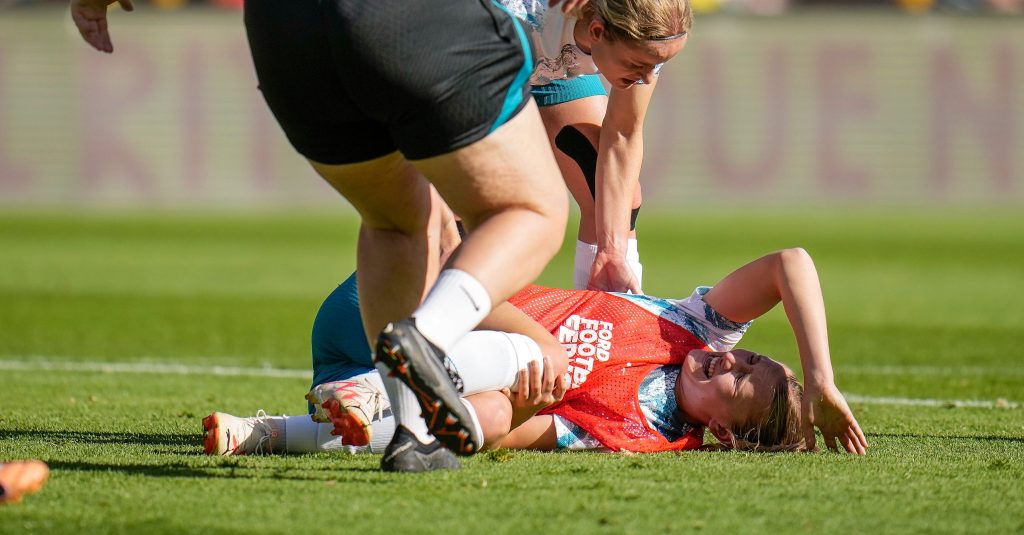
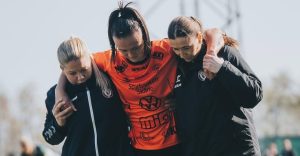
Photograph: Photosport NZ
The Wellington Phoenix coach fed Marisa van der Meer the ball on her left. She turned smoothly and struck the ball effortlessly into the goal. The next pass was played to her right side. She turned and hit the shot, landing on her right leg.
“Then it hyper-extended and I lost control,” Van der Meer remembers. “I just fell to the floor. It was a little bit of a shock. I was like, ‘No, not again.’”
Just when she thought the end of her rehab was in sight, the New Zealand footballer re-ruptured her anterior cruciate ligament (ACL) – just six months after suffering the injury the first time.
Van der Meer had worked so hard to be able to even start passing, dribbling and shooting the ball again. In one moment, all that work crumbled and her hopes to be back playing in the new year were shattered.
“Your mind is set on that return; it was meant to be at the end of this year. That plays with your mind a lot. It’s like starting from scratch again and that can be difficult to comprehend,” she reflects. “You have one set mind and then one incident can just change that, which is pretty crazy.”
Before the first rupture, Van der Meer was in Colombia with the New Zealand national team, called up as a last-minute replacement for Macey Fraser, joining the squad for the first time since being selected for the Tokyo Olympics.
“I was actually up in Auckland with Phoenix,” she explains. “I literally found out while I was there that I was asked to go, so I had to fly back to Wellington, grab my passport, fly back up to Auckland and then head out.”
Van der Meer flinches and takes a sharp intake of breath when I mention 2 December 2023.
Named amongst the substitutes in the first of two games in South America, Van der Meer was “just doing the normal things in the warm up [when] I went out to press the person with the ball, they went the other way, and I planted my leg and twisted”.
She then says slowly: “As soon as it happened, I fell to the ground. And I was like, ‘Oh, this does not feel good.’”
When it first happened, Van der Meer was wary to not jump to conclusions. “There were a few mixed emotions. I hurt my knee but I thought it wasn’t that bad,” she says ruefully. “We tried to test it out and I could hop, but it was a bit unstable and not very comfortable. The instant pain had settled down, but then obviously it swelled up.”
After she had a scan on her knee and the news was confirmed, she explains that she “definitely took time to process. It was a big injury and I knew that there was a long rehab journey ahead. I went home to Christchurch to have my surgery and to be with family. Those first couple months, and definitely that first month around my surgery period, I prioritised being at home.”
Soon afterwards, Van der Meer headed back to Wellington to continue her rehab at her club. “That was where I was going to get great facilities and rehab. That is what I chose to go for and it was great help from the Phoenix and support that they gave,” she says.

Van der Meer is grateful that in that first stage of rehabilitation, she had access to the club’s physios, strength and conditioning coaches and had the option of a sports psychologist. The professional space was “really helpful and it shows you that you’re on the right track.”
Then came the inconceivable and fateful training session where she fell down again. “You try to prepare yourself for those moments, but I was rehabbing and I just happened to do it again,” she says.
Following the re-rupture, Van der Meer and Wellington Phoenix agreed to terminate her contract to allow the player to complete her rehabilitation in Auckland, away from the club. The club will offer her a new deal should she be fit enough to return for the 2025/26 season, which she believes “gives me that motivation in my rehab to know I’m working towards that, whenever that’ll be.”
“Having done it again, it’s been a very emotional rollercoaster,” she says. “[That decision] definitely came from me, and the club were always just going to support whatever decision I did make, whether that was to go back [to Wellington Phoenix] or whether that was to stay in Auckland.”
Her second period of rehabilitation has been far more independent and she is keen to focus on taking each day as it comes.
“I think I’ve come out of this definitely on the upside. My attitude is definitely focused on taking my time. Although, obviously, I didn’t expect to have this much time to come back,” she laughs, in spite of the natural disappointment. “I am just trying to use the days the best I can.”

One of the positives of her second rehabilitation process has been being surrounded by a more settled and trusted support network amid a massive test of physical and mental strength. “With these injuries, even just that whole process of returning to the pitch and playing, there’s a huge element of being resilient, and having that determination and drive,” she says. “I felt like I needed that other additional support outside of the football sphere.”
Van der Meer still dreams of representing her country and has her mind set on a return to playing – but her injury has allowed her to find positives off the pitch. She recently graduated from university and has a job working as a physiotherapist, a career that she is determined will allow her “to really help people in their own journeys with certain injuries, and provide the best health care”.
Despite its prevalence in women’s football, few people will suffer the pain and torment of an ACL injury, let alone a re-rupture, but Van der Meer is hugely positive and determined to use the setback she has faced for good. Physiotherapy is her outlet to help others.
She smiles thoughtfully before saying, “I just want to help people through a difficult part of their lives, being injured. I just ask myself: ‘How best can I be positive in that experience?’”
Similar Posts
- Laura Holden: ‘I don’t want what happened to me to happen to anyone else’
- ‘I planted my leg and it felt like it exploded’: Perth Glory and Wales’ Megan Wynne’s ACL Story
- ‘I could not live with myself and be content if I quit’: Portland Thorns’ Nicole Payne’s ACL story

- ‘I never got to say goodbye the way I wanted’: Ayr United’s Taylor McGlashan’s ACL story

- ‘Finishing my football story, my way’: Partick Thistle’s Cheryl McCulloch’s ACL story
- ‘Every time I hit a new milestone, I had a mental breakdown’: Australia’s Amy Sayer’s ACL story
 Jack McRae writes...