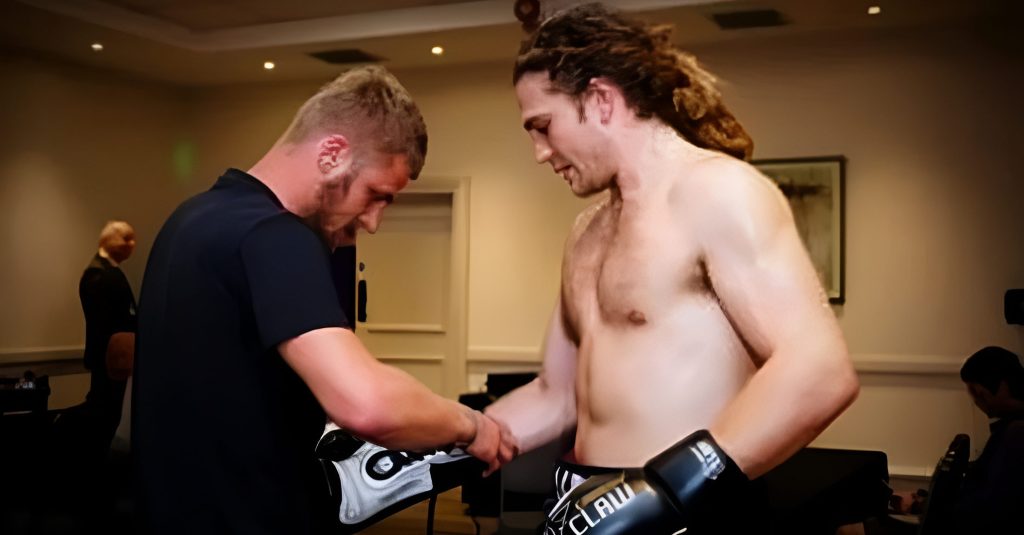
Photograph: Provided by Robbie Chapman
“This might sound a bit silly, but I’ve come to terms with knowing that I probably will end up with dementia in my lifetime,” Robbie Chapman says ahead of the first of three professional boxing fights over three successive weekends at Bethnal Green’s iconic York Hall. “I just feel like it is what it is. I probably will have dementia.”
Chapman is remarkably nonchalant about the prospect of severe brain damage that could impact his memory, language and motor control. When the 30-year-old faces Balraj Khara in a light-heavyweight contest on Saturday, he will be fighting his 55th professional bout and returning after an unusually lengthy absence for the journeyman boxer – five weeks.
“I don’t want to end up with dementia but, I mean, it is the thing that is going to be happening,” he says matter-of-factly. “If footballers were getting dementia from heading the ball for 10 years back in the day, then what am I going to get from 20 or 30 years of boxing?”
Boxing will almost certainly cause Chapman serious hardship and pain later in life. He has accepted an inevitability: what he loves so much will catch him with its own knockout blow. “I feel like there will be lasting effects from boxing, but that’s something that I’m willing to go with because I love boxing. I love the money that I’m getting from boxing. I just love all of it,” he says.
Chapman may be stoic in the face of a terrifying future, but he does fear facing this battle alone. “The only thing I am scared of is, I’ve got a missus and I’ve been with her for 11 years, and when we get older, I feel like I’m going to be the one that outlives her – unless I get hit by a bus, or I get cancer or something like that – I just feel like I’ll keep going forever. But, if she dies before me, and then I’m old and I’ve got dementia, then it’s gonna be bad.”
As a journeyman fighter, Chapman enters each of his fights as the underdog, considered a relatively jumpable hurdle for the inexperienced prospect in the opposite corner. When the bell rings, Chapman says he has “only got to worry about my defence, rather than going all out and winning.”
It is a career that suits Chapman. “If you’re in the home corner, you fight less regularly but you’re sparring more – and you get more damage during spars than you do in a fight,” he explains. “I fight every week and I can come out, nine times out of ten, without a cut, without a bruise.”
His defensive acumen does not make him invincible and he admits that “even though I’m not taking shots, you’re still bloody getting your head bashed out a bit.”
Getting hit in the face will hardly do wonders for the self-proclaimed ‘best looking journeyman in England’. Chapman laughs: “Have you seen me with a black eye? I look even better with one.”
Damage limitation, rather than victory, will be the plan again on Saturday when he fights Khara. Despite this more passive approach, Chapman has had relative success in recent fights.
He has had time, albeit just five weeks, to reflect on his last bout, a surprise points victory over Marcus Tomlinson. A shock result that meant when the referee raised his arm aloft, the victorious Chapman appeared as subdued as his 28-year-old opponent whose previously perfect record of eight fights and eight victories was blemished.
How can a man destined to lose feel when he does not? “When I go and nick a win or something like that, I just feel a bit bad. I feel a bit sad for the guy. I just feel like a bit of a dickhead,” he replies honestly. “I just feel bad because now they look bad. But they’re not necessarily any worse than other fighters.”

Photograph: Wikimedia Commons/Paul the Archivist
Chapman made his professional debut in May 2018, a points victory over Liam Griffiths, and won a further four fights before tasting defeat. Despite his flawless start in the ring, the young fighter faced an immense challenge outside of it.
He remembers: “I did my first fight and I could sell tickets. My second fight, that’s when selling tickets got hard. Then after the third, I was like, ‘I fucking hate this.’ The fourth, I was like ’I’m definitely going on the road.’”
Chapman dismisses the suggestion that he could have been given a helping hand. “My manager manages 100 people and, at the end of the day, boxing is a business. You and everyone’s trying to make money. No one’s out there trying to help you sell tickets. It’s not a charity, it’s a business and you can’t blame them for that.”
Chapman has no regrets in chasing the financial advantages as a journeyman. Last month he was still working full-time as a caretaker at Regent High School in Camden – the origin of his ‘Camden Caretaker’ nickname. Boxing has allowed him to switch to a part-time position at the school.
He hopes to use the extra time to build his personal trainer business and explains that, “when I retire from boxing, I want to have a stable of fighters; three or four journeymen and maybe one home fighter.”
Chapman has already secured his professional coaching licence and is on his way to making that vision a reality. Boxing is his life and even when he can fight no longer, he will refuse to let go.
“I’m not some poor, rough kid but I was never going to be like a really rich person. I’m not that clever. My family ain’t that rich. We’re just normal people with normal jobs,” Chapman says. “But I’d always thought that, with boxing, your journey doesn’t matter because eventually it’s all going to pay off. Everything is going to work in the long run.
“Boxing gives you hope, it gives you a fucking reason to think that everything is going to be all right because I’m a boxer.”
Chapman’s love for the sport is undented and, while trying to avoid repeating any cliches, he credits its ability to help people. “I’ve been in boxing for 15 years, I’ve been to gyms in some shit, rough places, I’ve probably sparred 1000 people and I’ve had nearly 100 fights and I could count on one hand how many people I could say, ‘He’s a dickhead,’” he explains. “There is something about boxing that when you do it, it just sorts you out.”
There is also something deeply bittersweet about Chapman’s relationship with boxing. He cannot and will not stop fighting, despite the knowledge it will cause irreparable suffering later in life. He will forever chase that next fight until, he says, “the easy fights become hard fights” or “I have a brain scan and something shows up; then that decision will be made for me.”
Why does he fight, knowing what could happen? “Because I love it. I absolutely love it, just love it. I just love the whole thing,” he emphasises. Chapman wants to, and believes he can, have at least 100 fights as a professional.
“From the first time I ever did any boxing when we went to the park after school, I loved it and had to go to a boxing gym,” he says energetically. “Then I started doing that and I was like ‘I want to fight.’ When I started to fight, I wanted to do it more.”
He will fight three times in the next three weekends, but Chapman’s toughest challenger lies beyond, when he has long hung up his gloves – whenever that may be.
That is the thing about boxing, Chapman says: “You always want a bit more.”
Similar Posts
- ‘You cling to the highs, but the lows really hit you’: The life and hobby of boxing coach and film director Jon Pegg

- ‘My dad left a legacy, I want to do the same’: Lenny Hagland on building Islington Boxing Club, fighters and a community
- ‘I need to process, I need to find the love again’: Joshua Al-chamaa on CrossFit, death and new beginnings

- ‘When I nick a win, I just feel like a bit of a dickhead’: Robbie Chapman’s career as a journeyman boxer

- ‘You need somebody to guide you down the right path’: Isaac Chamberlain and Adam Azim’s fight against knife crime

 Jack McRae writes...