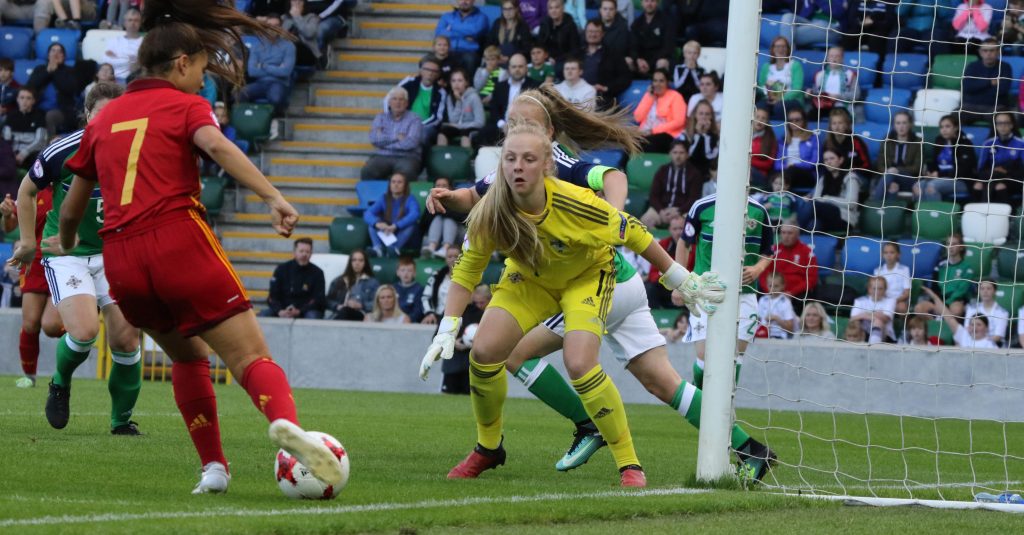
Photograph: David Hunter / Alamy Stock Photo
“I’m petrified and I’m very open about speaking about that,” says Lauren Perry, the Montrose goalkeeper who has won six caps for Northern Ireland. “I am petrified that it could happen again because I never thought that it would”.
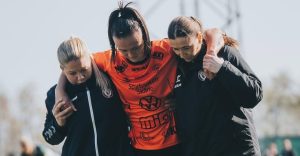
Perry has faced a great torment three times and, with each rupture to her anterior cruciate ligament (ACL), fighting the mental and physical torture becomes a tougher challenge. “When it happens, you just want your own time to process it and come to terms with it. Why is this happening? Why at this time? Unfortunately, we’ll never have the answers to that,” Perry sighs.
She was not scared when, aged 17, she first injured her left knee. Nor was she scared when she injured her right knee. Now, six years later and with her left knee sidelining her again, Perry cannot bury her anguish.
“I think I got over that fear when I did it on my left and on my right. I was back playing and I never thought it would happen again. It never, ever crossed my mind,” she says.
The manner in which Perry ruptured her ACL most recently makes the setback all the more frustrating.
“I can still remember it so clearly,” she says of having to dive on a loose ball from an Aberdeen corner. “I lunged and I felt it straight away. I shouted over to Cassie Cowper [her Montrose teammate] to get the physio. I was like, ‘It’s happened.’
“I lunged,” Perry repeats. “I do that 100 times in a match. I just don’t know why this has happened. That’s the hardest thing. It has been hard to know why it happened and understanding what I could have done differently.”
Perry laments the fact that “the timing of them is just rubbish” and she finds it hard to keep picking herself up with each blow. “I just want to get back to playing and enjoying football. I had kind of fallen out of love with the game, and I took a step back from the international setup,” she explains.
Despite making six appearances for her national side, it can be hard to separate her suffering and international duty – intertwined by unfortunate circumstances.
Perry had already made her Northern Ireland debut before she suffered her first ACL injury and knew the difficulties of the turbulent path that lay ahead of her.
“I was preparing myself for six weeks on the sideline when I went for the scan,” she says. “I joined up with the senior squad camp, and the doctor told me there and then. I remember I was with Alfie [Wylie, the Northern Ireland coach at the time], the doctor and my dad and I think we were just in shock.”
With clarity over her injury, Perry was able to walk without crutches – a facade of recovery that hid the long rehabilitation journey that awaited.
“I went to breakfast with the [rest of the team], and obviously I’m off my crutches, so everyone starts cheering and clapping me. I just got a proper lump in my throat and then I told them and I just remember seeing all their faces drop,” Perry says. “I was so young; I didn’t actually know a lot about the injury. I didn’t know the process. I didn’t know how severe it was. I didn’t know how common it was.”
Perry recovered from her first injury and reclaimed her place in the national team setup, but another ACL injury stopped her career once again. A blow that ruled her out of playing in the 2022 European Championships and forced her to take a step back from international football.
After her European Championship heartbreak and, she says, finding acceptance that “maybe it wasn’t meant to be, I wasn’t meant to go,” Perry focused on building back her form and confidence at Montrose in the Scottish Women’s Premier League. A string of impressive performances caught the eye of the new national team coach Tanya Oxtoby who convinced her to return to international football.
“Tanya came in and I went back. I was enjoying football again,” Perry explains, “I’d only been back a season playing and got back in the international setup. I just don’t know why this has happened. That’s the hardest thing.”
While Perry admits that, at times, she has almost succumbed to her fears and stopped playing, giving up has never truly been an option – despite a number of doubters suggesting she should.
“When it happens, a lot of thoughts go through your mind, especially this third time,” Perry says. “I’ve had a few comments where people said, ‘I’m even surprised that you’re going through it,’ or ‘I’ll be surprised if you come back.’”
While Perry’s skin is thickened by the trauma of three career-threatening injuries, she is not immune to incessant judgement.
She remembers the scrutiny she faced after recovering remarkably quickly from her first injury. At 18, it was hard to block out that pressure.
“I came back within six months and other peoples’ comments were affecting me. Telling me I was coming back too early really played on my mind. I didn’t know if it was true or not. I was just going with the physios and my surgeon,” Perry says softly.
Yet the memory of those comments returned to haunt the conversation she would have with a doctor after her second ACL injury.
“He told me that I couldn’t play football again,” Perry pauses, before explaining further. “I had a blood clot not long after surgery. I had to call 111 and then go to my local GP. Unfortunately, blood clots run in my family and the doctor said that, if this became a recurring thing, I’d be on blood thinners for the rest of my life and I couldn’t play football again.”
Hearing the doctor, Perry froze. Unable to comprehend the suggestion, she had to rely on Susan, her “Scottish mum” – in the family Perry lives with – to tell the doctor the words Perry could not articulate herself.
“Susan said to the doctor, ‘I don’t think you’ve just realised what you’ve said to this young girl,’ and his face just dropped,” Perry remembers. “I never really said anything. I just sat there thinking this isn’t going to happen. This is ridiculous. What he’s saying? This is why I’m in Scotland. This is why I’ve moved away from my family. I want to play football. The words went in one ear out the other. I couldn’t really believe what he was saying, but I knew for a fact that that wasn’t going to happen.”
Perry is not a full-time professional footballer and she explains that “in my position, it’s even harder because I have to go to work. I either do my rehab before work or after work. So finding that extra motivation to do it is extremely hard. You just have to remember what you’re doing it for.”
Despite this, Perry finds extra motivation through her work as a deputy service manager for children with disabilities.
“What’s happened to me isn’t that bad. It may seem bad, but no,” Perry says. “I have to look at it from that perspective. I’m helping the [children] achieve their goals, so I also need to push myself. I can’t make them do something if I’m not even going for something myself.”
Football may be cruel but Perry is not ready to give up on it just yet. “I love football. It is definitely a love-hate relationship at times, but mainly love,” she laughs.
The young goalkeeper is adamant as she says, “I’m not done. I’m not down and out. I have still got things that I want to achieve within football. I want to get back to the pitch and I want to try to achieve them.
“It is for myself and to prove the people wrong who have said that I’m not going to come back. I want to push myself to see where I can get to.”
Perry has the determination of someone who has been to hell, a journey she has made three times, and is on her way back again.
That fear of doing it again, she says, “will probably be in the back of my mind for a while but I’m going to push myself really hard and, on those hard days, I have to remember what I’m doing it for. That moment when I step back on the pitch will be a great day.”
Similar Posts
- Laura Holden: ‘I don’t want what happened to me to happen to anyone else’
- ‘I planted my leg and it felt like it exploded’: Perth Glory and Wales’ Megan Wynne’s ACL Story
- ‘I could not live with myself and be content if I quit’: Portland Thorns’ Nicole Payne’s ACL story

- ‘I never got to say goodbye the way I wanted’: Ayr United’s Taylor McGlashan’s ACL story

- ‘Finishing my football story, my way’: Partick Thistle’s Cheryl McCulloch’s ACL story
- ‘Every time I hit a new milestone, I had a mental breakdown’: Australia’s Amy Sayer’s ACL story
 Jack McRae writes...