
Photograph: Michael Smolski (@michaelsmolski/@ftbliseverywhere), provided by Amy Sayer
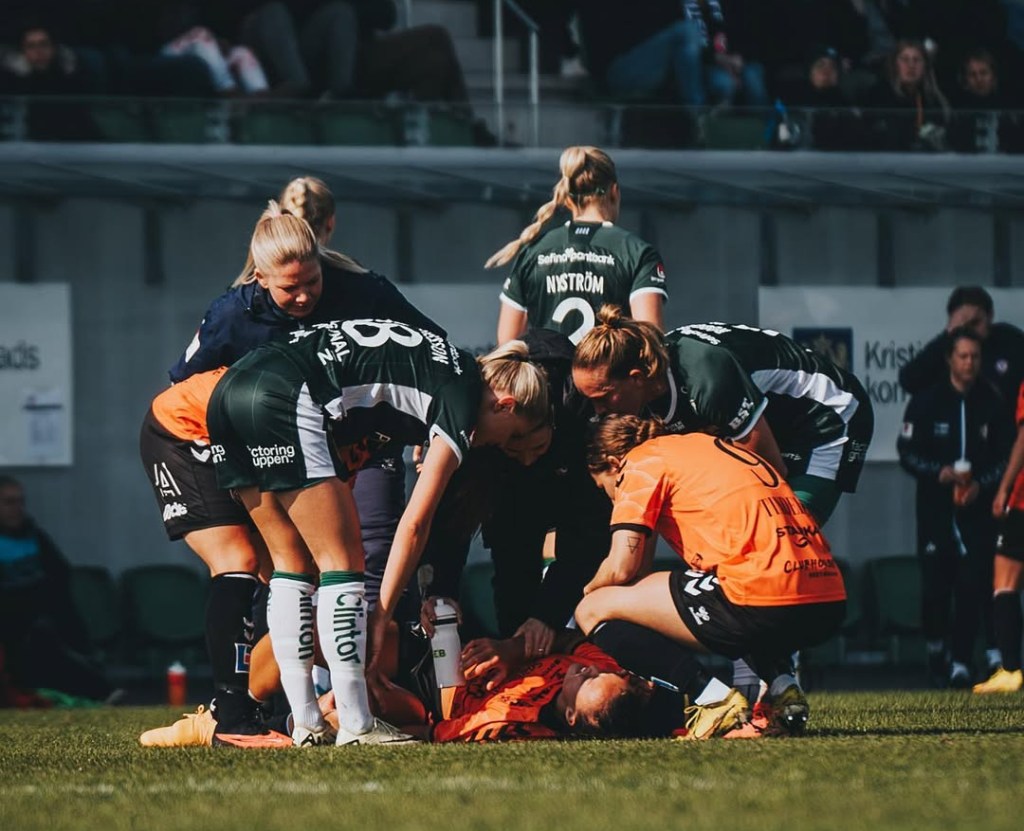
Amy Sayer, the Australian international midfielder, was playing for Kristianstads DFF at Hammarby in Sweden when she went to block a ball, changed direction and put all her weight down on her left leg. Suddenly, she says, “it felt like my entire knee dislocated a kilometre to the left.”
In that excruciating and shocking moment, it felt as if Sayer’s entire world had collapsed. The 23-year-old had already achieved so much. She passed up on the chance to go professional at 18 to move to the other side of the world and study at Stanford – a “difficult” choice that allowed her to play football as well as study for a biology degree.
But football was her abiding passion. Capped 11 times for Australia already, and with her gaze fixed on the 2023 World Cup in her home country, Sayer was inadvertently becoming a cultural icon. Young Asian-Australian girls could see how the Matilda star, born to a Chinese mother, was breaking new ground for them.
Chasing her World Cup dream across the world led her to Sweden – and devastation. She did not know it then, but Sayer was about to rupture her anterior cruciate ligament (ACL) and join an exclusive injury club that has had calamitous consequences for so many female footballers.
“It was a terrible pain, and I went down immediately,” Sayer continues. “I watched the replay, and you could hear me screaming out. I had my hand over my face, I was on the floor in so much pain. I don’t think I was crying. I was just thinking, ‘Oh my God, I’m in so much pain.”
The Kristianstads DFF physio rushed onto the pitch and tested to see if Sayer might have ruptured her ACL. “She knew immediately.” Sayer says. “But she couldn’t tell me. She didn’t know how to tell me, or whether she should tell me. There was no reason to say it at that point.”
Sayer was helped off the pitch before having a scan the following week to confirm what the physio had already diagnosed.
“I feel like I came to terms with it almost immediately. I knew that something bad had happened to my knee. When I went into the doctor’s office on Monday, the surgeon told me and he was surprised that I didn’t just burst into tears. But I already knew it, he was just confirming the facts.”
Sayer had her surgery in Sweden and spent the first six months of rehabilitation with her club, a time which she says, “has been probably the hardest in terms of injury.”
Sayer, who is currently back home in Australia during the post-season break, had suffered previous and testing injuries. A stress fracture in her foot kept her out for five months and the 2019 World Cup but, that, she explains was “like peanuts compared to this.”
One of Sayer’s biggest torments is in the fear that, now having injured her ACL once, it could happen again.
“I never really worried about it before. You have that feeling of it would never happen to me, then it does. Now the thought of doing my other one, or even this one again, is more present in my mind than if I hadn’t [been injured],” she explains. “In those first few months of this recovery, I said, ‘God, if I do another one, I’m just going to retire. I’m going to quit.’ It was so hard.”
Does she still think she would quit if she injured her ACL again?
She pauses before replying, “I think I would keep fighting, but months two to five are the toughest. I wouldn’t tear it and then say ‘I quit now’, but that’s how severe the injury is and how difficult it is. I’ve played the sport my entire life, for 20 years, and the thought of just doing another one makes me want to quit. I think that’s crazy.”
Sayer’s recovery was made all the more difficult by the uncertainty she felt through those first few months, even though she knew she was making positive progress. She remembers how “every time I hit a new milestone, I had a mental breakdown. You start to fear that you’re never going to be the same.
“When I started walking again, I still had a limp. Then I thought, ‘God, if I can’t even walk, how am I ever going to run again?’ Then when I started running, it just didn’t feel right and nothing quite felt connected somatically in my body. I thought, ‘How can I even think about kicking a ball?’ It is those little things that really were the hardest.”
She is grateful that she has friends in other professional footballers who have injured their ACLs too, although she knows this support comes from a shared trauma.
“It’s definitely an ACL club, but no one wants to be part of it,” Sayer laughs. “Even though in women’s sports you know that it’s right around the corner at any point, until you do an ACL, you really don’t know what you’re going through.”
Despite being part of an exclusive injury club, Sayer believes that, “it is still a very individual journey. Everyone is different and you have to battle it out.”
Sayer is a hardened battler, having fought through several upheaval and setbacks – almost always on her own. Moving to America and then Sweden has prepared her for such a fight back to fitness.
“That’s maybe made my recovery a little bit easier, being able to hunker down and get my gym programmes done,” she says. “If it was my first time being abroad, and I’ve done my ACL, I think that would be a really, really hard thing.”
Suffering an ACL injury has only reaffirmed Sayer’s understanding that a career in women’s football is finite. She is studying a Master’s degree in bioethics with the intention of becoming a lawyer or a medical ethics consultant.
“From a very, very young age, in our house, academics is always first before football,” she explains. Although going to college in the US meant her development as a player plateaued compared to her Australian teammates, she has no regrets. “That’s the price you pay,” she says frankly.
“I graduated from Stanford around August last year and then I had all this time on my hands. I am suddenly in Sweden, I’m bored and I didn’t know what to do with myself. What else would you do, except apply for a master’s degree?” she laughs.
Sayer’s academic pursuit is admirable, even though she is unable to see it, or herself, as such.
Rather she credits the Australian national team’s role in allowing each player’s personality to ‘shine’ and describes representing her country as “everything you dream of when you’re a kid.”
She is desperate to add to her 11 appearances for the Matildas and, despite injury hurt and selection heartache ruling her out of two World Cups and one Olympics, she is determined to return in time for the 2026 Asian Cup being held in Australia. For Sayer: “That is my World Cup at the moment.”
There remain hurdles and challenges in her recovery but, as is typical of her understated manner, Sayer downplays the moment she returns to the pitch. “I think it’ll be exciting, but I don’t want it to be some sort of momentous occasion. I feel like if you build it up to be, something bad could happen. Whether that’s just me being superstitious or something, I’m not sure,” she says coyly.
The young midfielder insists she is just taking it “one step at a time, but the goal is to reestablish myself in the national team and hopefully work my way towards that Asian Cup and get some good minutes there.”
Sayer’s maternal family are Chinese and she has been credited as an inspiration for Asian Australian girls, although again she brushes away the suggestion. “If there are young Asian Australian girls who see themselves in me, then that’s amazing. It’s not something that I think about a lot but, if that’s the way that it is, I’m very grateful that that’s how it appears,” she says.
It is clear that Sayer has not been swept up in the excitement of being a professional footballer. She says she still finds it strange when “we’re getting stopped on the street. I’m like, ‘You want my photo? Why? I’m just a normal person.’ It doesn’t quite hit me.”
Being a role model is not a responsibility Sayer has sought, but the weight of being an Australian international footballer is not lost on her.
“I think everyone on the Matildas is a role model just by virtue of our position,” she says, before adding finally: “I think the priority has to be just conducting yourself in a way that is becoming.”
Sayer’s effortless intelligence and drive may not be apparent to her, but it is clear why she is such a beguiling figure to so many young Australians. She has fought through so much adversity and come out the other side, now she will battle back from an ACL injury to become an even stronger and better player, and person.
Similar Posts
- ‘I planted my leg and it felt like it exploded’: Perth Glory and Wales’ Megan Wynne’s ACL Story
- ‘I could not live with myself and be content if I quit’: Portland Thorns’ Nicole Payne’s ACL story

- ‘I never got to say goodbye the way I wanted’: Ayr United’s Taylor McGlashan’s ACL story

- ‘Finishing my football story, my way’: Partick Thistle’s Cheryl McCulloch’s ACL story
- ‘Every time I hit a new milestone, I had a mental breakdown’: Australia’s Amy Sayer’s ACL story
- ‘I just don’t know why this has happened’: Montrose’s Lauren Perry’s ACL story

 Jack McRae writes...