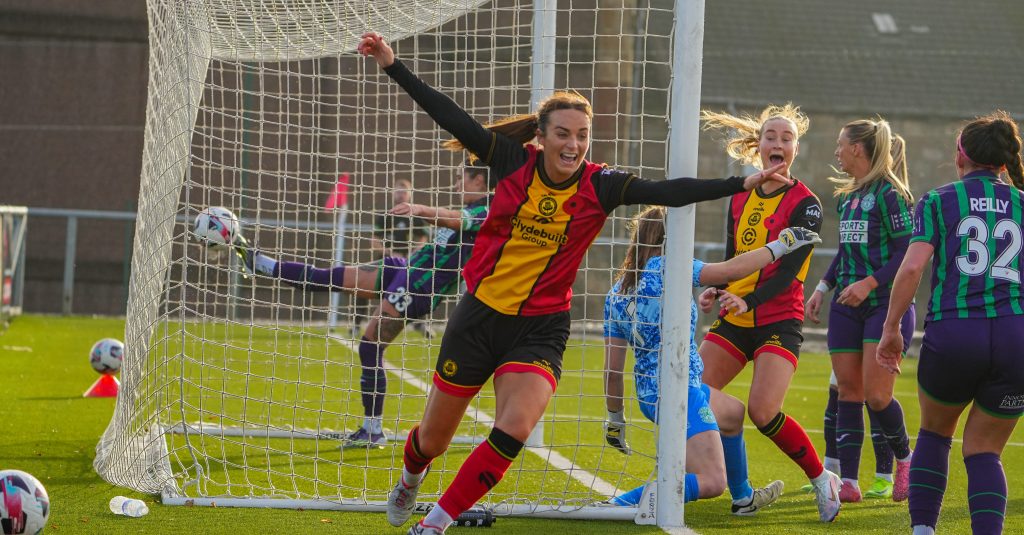
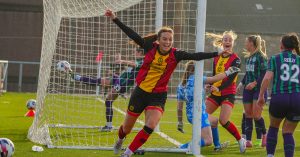
Cheryl McCulloch celebrates her first goal back since her ACL injury, a header from a corner against Hibernian. Photograph: 41sportsmedia, provided by Partick Thistle
“It was pretty, pretty lonely,” Cheryl McCulloch says quietly of the 564 agonising days spent fighting mental and physical blocks to return to a football pitch. “You can go through phases where you start to withdraw yourself from a group environment. That’s when it becomes tough.”
Being part of a team is all the 35-year-old Partick Thistle defender has known. From playing for Scotland at under-17 level to working night shifts in the fire service, McCulloch has always been surrounded by a close-knit group.
Never before had she been sidelined from such a collective until, on 1 March 2023, she ruptured her anterior cruciate ligament (ACL) five minutes into a game at Rangers.
“It pretty much had an effect on my whole life,” she says. “I’m not going to lie, I would feel a bit isolated. You’re still part of a team, going to games and training, in the dressing room, but as soon as they go out on the pitch, they’re away and then it’s silent. That was the hardest part.”
McCulloch is one of four players to have suffered an ACL injury at Rangers’ Broadwood Stadium since the start of 2022. “It is quite a notorious ground,” McCulloch explains with an edge to her voice, before continuing more sombrely. “We had a corner and it has come back out to our side. I sprinted to close down and stop the counter attack and I put my left leg up — I don’t even know why I put my leg up — and then my right knee twisted in the turf. Then you hear: ‘Pop’.
“The pain is excruciating.”
After being stretchered off, the pain started to ease and the doubts crept in. “I started to panic. Then I began to think I’ve really dramatised this here and maybe it’s not as bad as I thought. It also took a bit longer for us to confirm the news as we didn’t have MRI immediately available to us. I was proper second guessing that I’d done something,” she remembers.
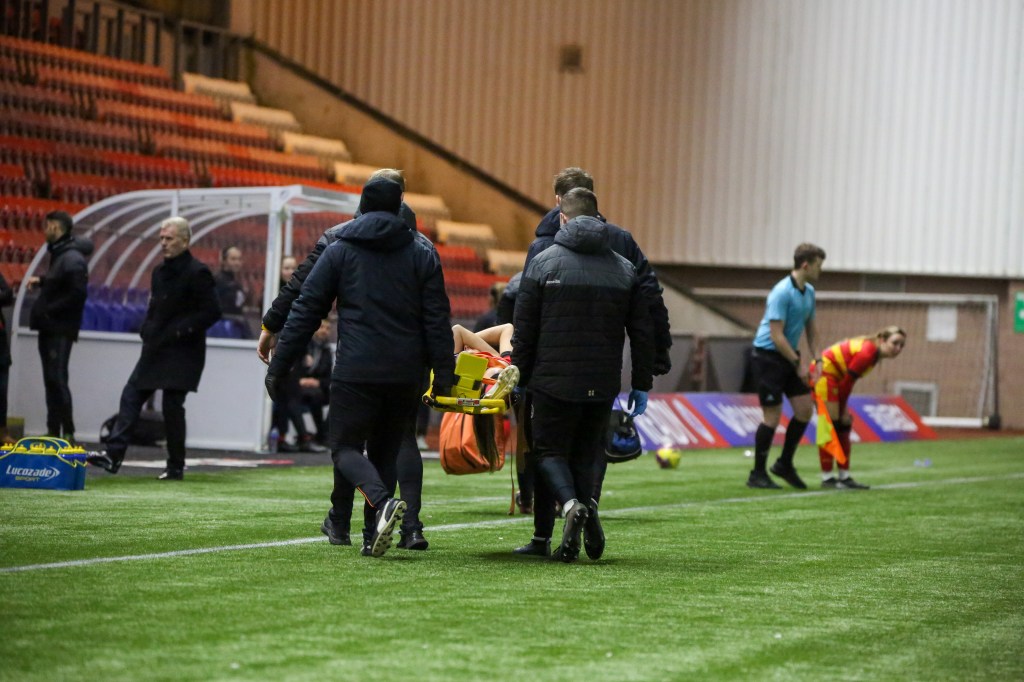
The news was confirmed eventually by her coach, Brian Graham, but McCulloch could already tell she was facing a daunting journey back to the football pitch.
“Brian gave me a phone call and I just knew by the tone in his voice. He just said, ‘I’m so sorry, but don’t worry. Whatever happens, we’ll get you back on the pitch. We’ll support you.’ But, in that moment, you’re not even thinking. You’re already spiralling,” McCulloch says.
By her own admission, McCulloch was “no spring chicken” when she suffered the injury that has cut many footballers’ careers short. “I didn’t know whether I would come back or not because it’s such a big injury. You need to think about your work and life after football and, at my age, it was devastating to hear.
“It was the same with the fire service. I went on light duties and I was at a desk on my own a lot of the time. Even as much as everyone around you is trying not to make you feel like you are left out, you do,” she says.
While players from professional clubs may only have to wait a matter of weeks for surgery, McCulloch was left in limbo until her own procedure in August — a painful five month wait. She explains: “There were one or two points where I was really low and struggled with injury. You spend a lot of time thinking, ‘Am I going to make it back?’”
In the twilight of her career, would it not have been simpler to retire?
“There was a bit of stubbornness in me,” McCulloch replies. “There were a lot of people that I think expected me to quit. I was genuinely thinking I only had one more season in my legs but when that gets taken away from you, it’s almost like, ‘No, I don’t want to finish like that.’”
Her desire to return to football was surprising to some. “A lot of people, even people from my work, were saying it’s causing so much hassle to have surgery, to do all that and then go back. But they didn’t really understand my passion for football.”
That passion motivated McCulloch through almost two years of torment but, by the latter stages of her recovery, she was desperate to be back. She emphasises that, “there was a slow build up. The process felt very slow and I wanted it to be a lot faster. I was on the pitch training and I just kept thinking: ‘Am I not ready?’ and ‘Why am I not ready?’”
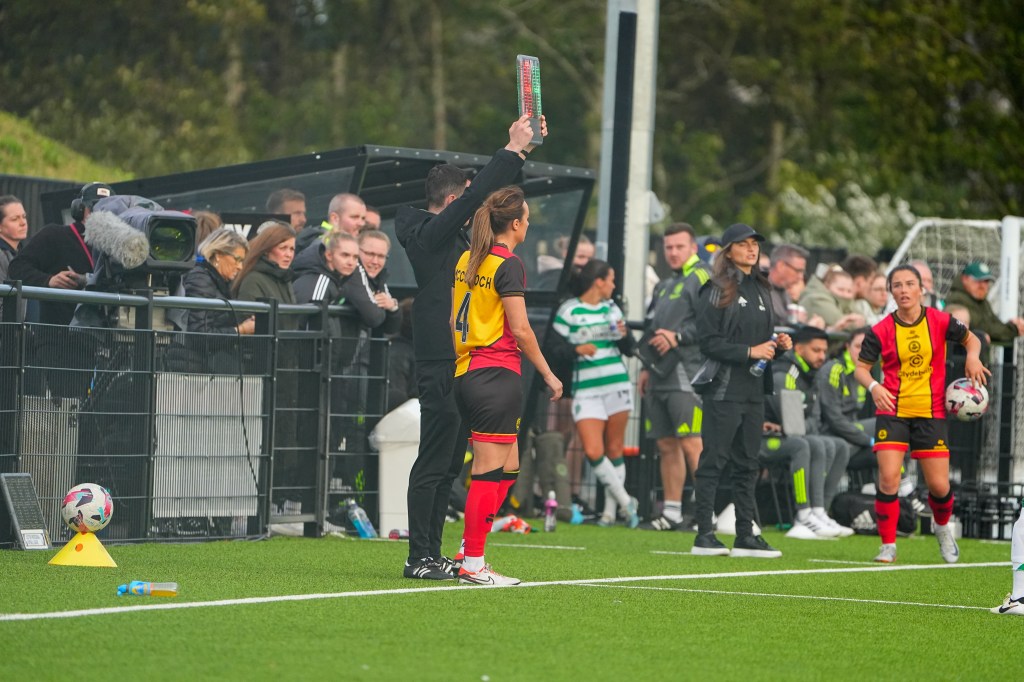
Despite being physically prepared to return, the moment McCulloch stepped back onto the pitch was difficult to comprehend. “It was a whirlwind at the time. I wasn’t expecting to come on. The game was pretty much done. We were getting beat 3-0 by Celtic and with 20 minutes left, Brian just turned around and said to get warmed up.
“It was so quick that by the time I’d warmed up and had my shin guards on, I was like, ‘Oh my God.’ It wasn’t until after the game that I realised, ‘Wow, I just played some minutes there.’ It was a really nice feeling but, at the time, maybe a bit overwhelming,” she laughs.
Even just 20 minutes back brought “a huge sense of relief,” she says. “Within a couple of minutes, I’d already had my first contact tackle and I didn’t even think about it. I knew it was the right moment when that happened. There were no what ifs. I was back.”
McCulloch has also returned to her shifts on the run in the fire service, a job she has worked since qualifying in 2019 while at Celtic.
“I think it’s very similar to football. It’s a team environment. Every day is different. It’s challenging and you get to help people also along the way. It was something I always wanted to do.” she says. “Unfortunately, [I started] when the club was going through a bit of a transition period to a professional setup. I tried to do fire service and Celtic, but it was to my detriment.
“I was working night shifts and then going straight to training. I would get home from training, then go back to the night shift. I wasn’t really eating, I wasn’t sleeping and it was far too much. I probably stuck in longer than I should have but I loved the club and loved playing for that team so I did it for as long as possible.”
McCulloch is not bitter that going full-time at Celtic was not viable at that time, even though, she says, “if I was 10 years younger, it would have been a no brainer.”
She is incredibly proud that she was able to play for Celtic, the club she was brought up to support by her dad, for four years, as well as for Glasgow City where she played in the Champions League last 16 and won a number of trophies.
“There are so many good memories throughout and I am really fulfilled,” she smiles.
But McCulloch is not ready to leave it all behind yet.
A text from Leanne Ross, the Glasgow City head coach and McCulloch’s former captain at the club, continues to resonate and has only intensified her hunger to keep playing.
“She was gutted but said that I will be back and the best will come back. That always stuck with me because I want to be the best, I want to be back, I want to finish my football story, my way,” McCulloch insists.
And then, with solemn intensity, she adds: “I know this is my second chance to enjoy the last part of my football career. Whether it is this season or not, I need to just enjoy every training session and game like it is my last because you just never know.”
Similar Posts
- Laura Holden: ‘I don’t want what happened to me to happen to anyone else’
- ‘I planted my leg and it felt like it exploded’: Perth Glory and Wales’ Megan Wynne’s ACL Story
- ‘I could not live with myself and be content if I quit’: Portland Thorns’ Nicole Payne’s ACL story

- ‘I never got to say goodbye the way I wanted’: Ayr United’s Taylor McGlashan’s ACL story

- ‘Finishing my football story, my way’: Partick Thistle’s Cheryl McCulloch’s ACL story
- ‘Every time I hit a new milestone, I had a mental breakdown’: Australia’s Amy Sayer’s ACL story
 Jack McRae writes...