
Taylor McGlashan is assessed by the physio after injuring her ACL in her final game for Partick Thistle. Photograph: 41sportsmedia, provided by Partick Thistle
In May 2023, Taylor McGlashan walked onto the pitch against Hibernian for her last game as a Partick Thistle player. The club’s longest-serving player had joined the club in the third tier of Scottish women’s football and, six seasons and a promotion to the Scottish Women’s Premier League later, she was ready to step back.
“I spoke to [the manager] Brian Graham about it and decided that was going to be my last game. My family were there, my partner was there, my friends had driven to the game as well,” McGlashan says as she remembers what was meant to be her grand farewell. “Then, half an hour into the game, I’ve reached in for a tackle with my right-leg and my left leg has just twisted. I just fell to the ground. The pain was just the worst.”
McGlashan’s dream farewell became a nightmare – she had ruptured her anterior cruciate ligament (ACL). “I never got to say goodbye in the way I wanted. After being at the club years, being part of their promotion, I was absolutely devastated I never got to say goodbye. That was a difficult one to take,” she says ruefully.
Although she never felt the ‘pop’ so commonly associated with a cruciate ligament injury, McGlashan immediately feared the worst.
“I had to get stretchered off. I didn’t want to, but I had no choice. I didn’t know what I’d done, and didn’t want to make anything worse,” she explains. “I just remember lying in the changing room, thinking ‘I’ve done it, I’ve done it.’
“Everyone else is going, ‘No, don’t say that. You don’t know. It might not be.’ But, in your head, you’re thinking: ‘Oh my God, oh my God.’”
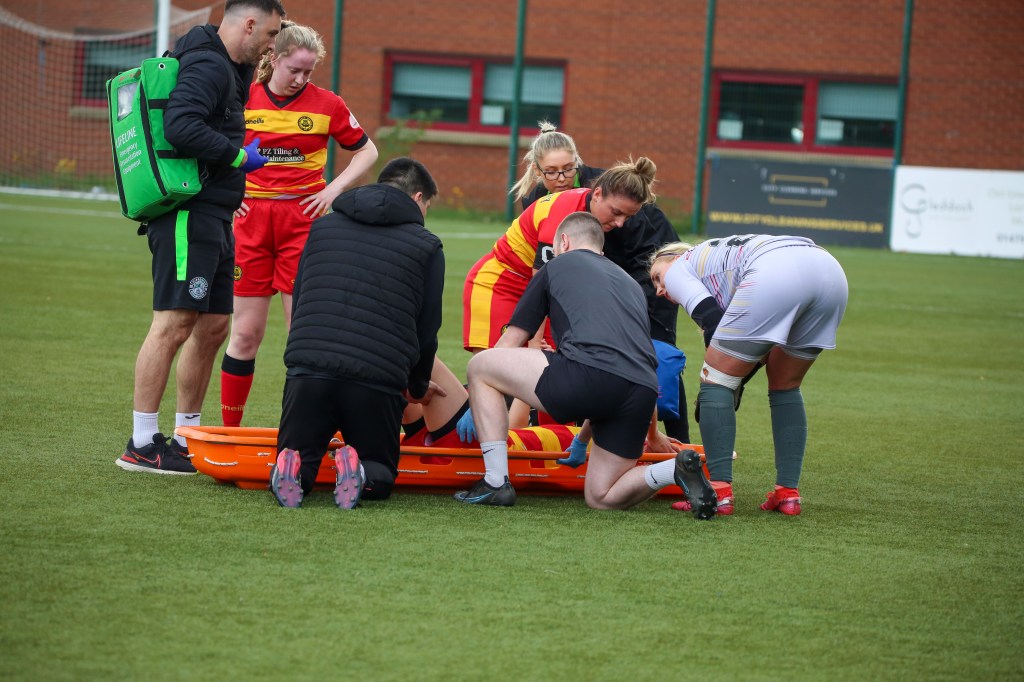
Photograph: 41sportsmedia, provided by Partick Thistle.
McGlashan had an X-ray that afternoon and left the hospital in a knee brace, still trying to avoid thinking of the inevitable career-shattering diagnosis. However, she could not hold the weight of what had happened for long.
“When I got home, I was just sat there with everyone and I broke down into tears. The adrenaline had worn off and the realisation that, if I’ve done this, I would have to wait for surgery. It could be two years and then I’ll be 34. Am I going to be the same player? I don’t even have a club anymore,” she says.
McGlashan had been in contact with a few clubs vying for her signature, but having injured her knee, any potential contracts disappeared. “I was thinking, if I’m doing this alone, what am I going to do?
“Then Brian rang me and told me, ‘Don’t worry, we’re going to support you all the way through your rehab and get you back on your feet.’ That took a wee bit of stress off me. I’m always going to be grateful because not many clubs would do that,” McGlashan says earnestly.
Demi Falconer and Cheryl McCulloch, the club captain and vice-captain respectively, then further reassured her that she would still be considered part of the team in her recovery.
McCulloch’s encouragement would also extend beyond her duties as vice-captain. She had suffered her own ACL injury just months before and the defensive partners became incredibly reliant on one another.
McCulloch’s own recovery was wrought with anguish, but she found solace and understanding in the presence of McGlashan. The feeling was mutual.
“I was very fortunate that Cheryl, in a weird way, had had her injury, because I don’t know what I’d have done if I was on my own. We bounced off each other,” McGlashan says. “It’s so important to have someone there who has been through it to support you – not just physically, but mentally as well, because it can become quite a dark and lonely place if you don’t have that support network.”
Did McGlashan ever find herself in that dark place? “I would like to say I am quite strong mentally but it helped that I did have Cheryl there to talk through the injury; my partner, parents and friends too. I was fortunate I never went there,” she replies. “Don’t get me wrong, there were days when I was also crying in bed, because it can become really, really overwhelming when you think about how much there was ahead.”
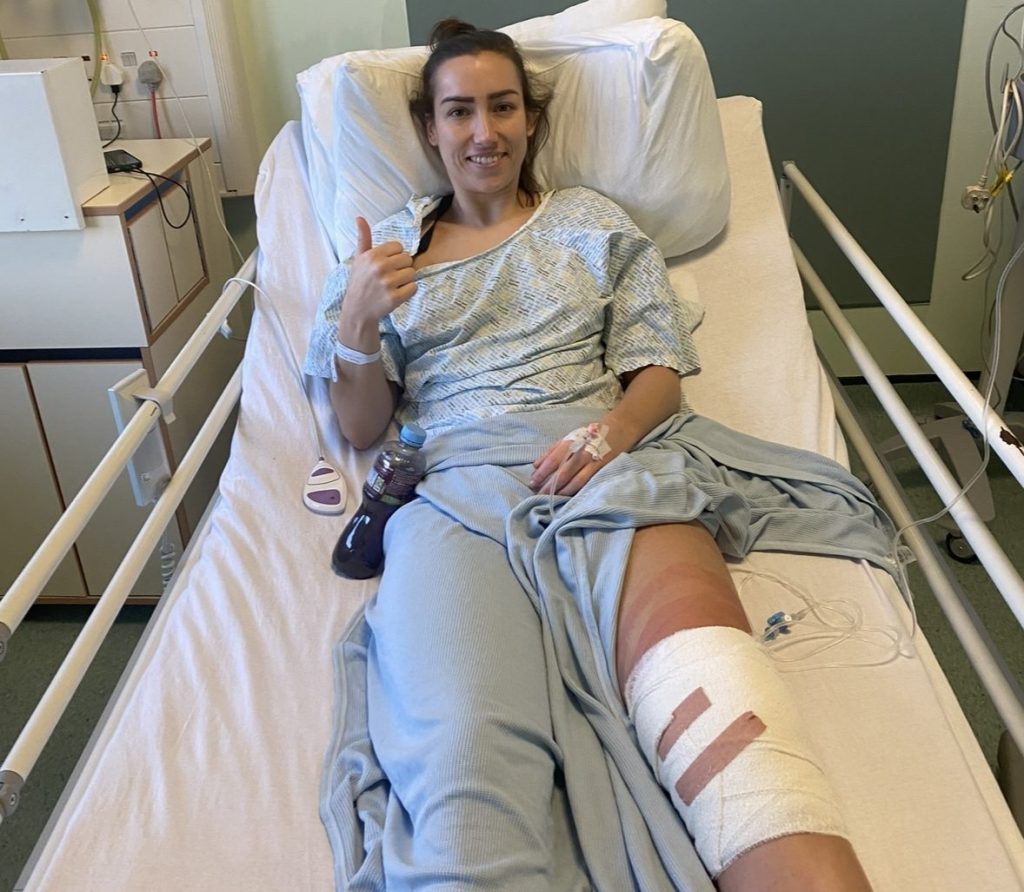
Photograph: Provided by Taylor McGlashan
Going through the NHS, rather than private healthcare, meant McGlashan was left waiting months to even find out the date for her surgery, let alone actually having the operation.
“It’s a bit of a waiting game. You’re just hanging about. You can’t really plan around it, because you don’t know when it is,” she explains. “My partner said it put me under a lot of stress. I like to have a routine, because I used to be in the Navy, and if I can’t do my routine, or it gets messed up, that sets me off a wee bit.”
Not having a date for surgery left McGlashan in a frustrating limbo. “I was quite nippy, quite short, just frustrated and sometimes you take it out on those that you love. I found it quite difficult and wasn’t probably the best partner in that initial three-to-four-month stage.
“I don’t know what I would’ve done without my partner. She was so supportive and was there for me – even though I was quite moody,” McGlashan laughs.
Alongside her footballing career, McGlashan works as a social work assistant at a hospital, helping those who have been discharged and she was able to take time off while recovering – a luxury, she is acutely aware of and grateful for, that others are often not afforded.
“Some people don’t have that chance and I couldn’t imagine the stress. When you are already dealing with your knee, you don’t want a financial burden as well,” she says.
Able to focus on her recovery at Thistle, alongside the help of a private strength and conditioning coach, McGlashan made a full recovery and was “ready to move on.”
Just over a year after she was meant to ceremoniously depart, McGlashan left Partick Thistle for a fresh start at Ayr United in the lower reaches of SWPL2.
Despite being in the latter stages of her career, the 34-year-old is loving the sport more than ever and, like a child in Sunday League, was itching at the prospect of stepping back onto the pitch.
“Strangely, I felt ready. I was just waiting on the side and I kept going up to the coach asking: ‘When do you think I’m going to go on?’” She smiles. “Then, I went on and couldn’t even think about my knee. I had quite a good 10 minutes. I made some big tackles and was just like, ‘Yes!’ I was buzzing.”
Her Ayr United debut marked the end of a lengthy and difficult time out for McGlashan who, despite suffering a devastating end to her career at Partick Thistle, was not ready to say goodbye to football.
“No way [would I have quit]. I wanted to end my way. I wanted to end when I’m ready, and I’m just not ready,” she insists. “I am just taking each season as it comes. This season, I am focusing on keeping Ayr United up and in SWPL2 and keeping myself fit and playing each week.”
But how long can McGlashan keep playing?
“I don’t want to be one of those old centre-backs trying to run and just getting ran past by a striker,” she jests before adding more pensively. “I’ve just turned 34 but I like to think I’ve got another couple of seasons left in me.
“I want to end my career on a high.”
Similar Posts
- Laura Holden: ‘I don’t want what happened to me to happen to anyone else’
- ‘I planted my leg and it felt like it exploded’: Perth Glory and Wales’ Megan Wynne’s ACL Story
- ‘I could not live with myself and be content if I quit’: Portland Thorns’ Nicole Payne’s ACL story
- ‘I never got to say goodbye the way I wanted’: Ayr United’s Taylor McGlashan’s ACL story

- ‘Finishing my football story, my way’: Partick Thistle’s Cheryl McCulloch’s ACL story
- ‘Every time I hit a new milestone, I had a mental breakdown’: Australia’s Amy Sayer’s ACL story
 Jack McRae writes...