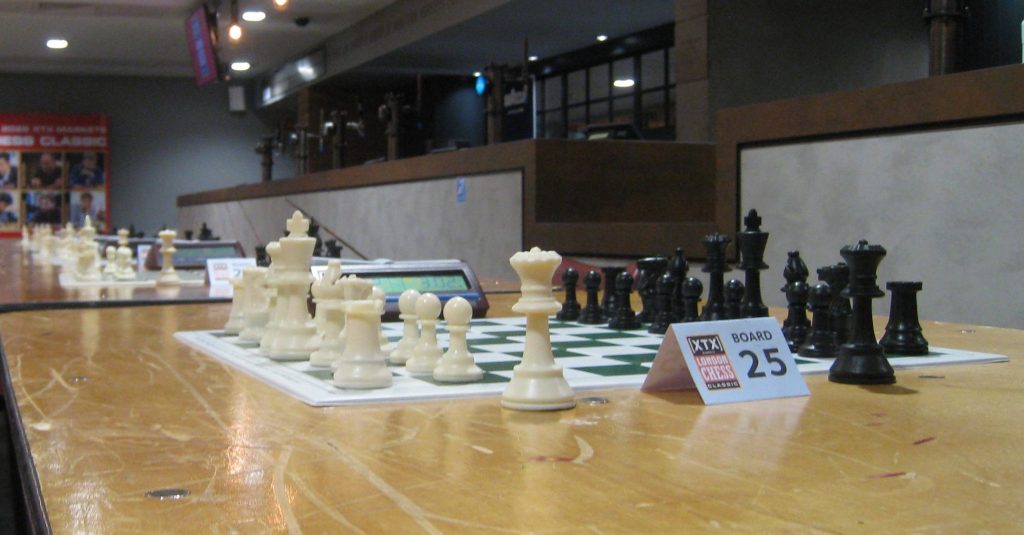
This week I watched chess. It is unusual to walk across the Ken Friar Bridge to a sporting event at the Emirates Stadium and not be among a sea of red, chanting in unison. On a blustery day in north London, the wind whips through the concourse, blowing me around the East Stand towards the Clock End where one set of metal gates point to an entrance to the London Chess Classic.
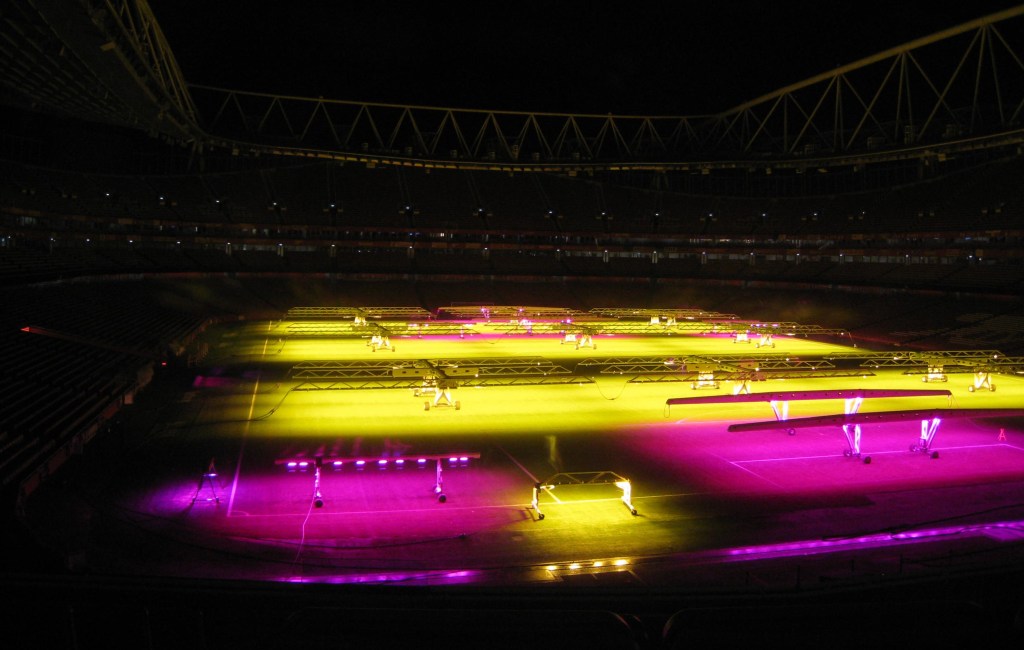
Ascending the escalator to the Dial Square club lounge, the first thing you see is the football pitch, lit up in a luminescent yellow and purple as the artificial growing lights shine down on the surface. Then you turn to see chess board after chess board, after chess board.
At first, it is difficult to absorb. With my experience of chess limited to playing against family members as a child, understanding the setup of a professional tournament boasting some of the best players in the world is beyond my level.
Bar the creak of plastic chairs, the squeak of shoes and howl of that wind, the elite tournament is held in almost complete silence. Phones are banned, photo opportunities are limited and the room is engulfed in a strange tension as countless pairs face off in hushed battle. There are four games amongst the elite taking place as I sit behind a red rope, metres away from the boards. Despite the closeness, seeing and understanding the moves and strategies is not easy; instead watching the players becomes my fascination.
Immediately in front of me, Nodirbek Abdusattorov (Ranked world #12) is up against Sam Shankland (#63). Abdusattorov, dressed in a suave all-black suit, has his head in his hands for much of the game, his body rocking back-and-forth slightly as his leg bounces ceaselessly. The 21-year-old Uzbek had been the leading player to this point in the tournament, winning each of his previous four games after drawing his first.
His opponent, the 34-year-old American, cuts the figure of a scrupulous lawyer deliberating over every minor, but all important, detail of a life-changing contract. Initially, Shankland sits upright with his head resting on his chin but, as the game progresses, he finds his head in his hands, often with his chair drawn back as far as possible, folding over and bringing himself eye-level with the crown of the King.
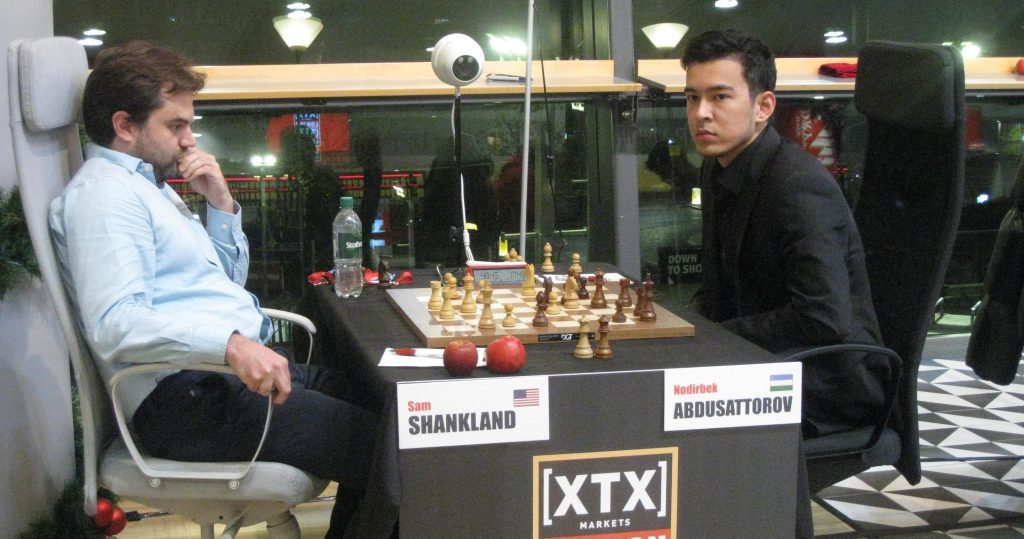
The pair unleash enormous, inaudible emotion with each move, their minds stewing and clattering around a million possibilities. It almost makes the shift of a piece a couple squares one way or another appear comically simplistic. The tension is finally cut when Abdusattorov moves his Queen three squares to his right and checkmates Shankland’s King. The pair do not speak, but shake hands and leave the room in silence.
The other game snaring my attention is between Alireza Firouzja (#6) and Abhimanyu Mishra (#68). Firouzja, the Iranian-born French grandmaster, is the highest-ranked player of the tournament and carries a swagger like he knows he is. He studied fashion design in Paris and, dressed in incredibly lax style, he wears a Supreme hoodie, black cargo trousers and a chunky pair of spotless white trainers. The 22-year-old could be playing in his living room.
Firouzja broke Magnus Carlsen’s record of becoming the youngest player to surpass the International Chess Federation rating of 2800 in 2021, beating the Norwegian superstar on a number of occasions too. Now the kingpin at the London Classic, Firouzja often leaves his seat after making his move, strutting by the other elite games, hands behind his back like an inquisitive old man.

Mishra is a young chess prodigy of his own. The 16-year-old American became the youngest ever grandmaster at the age of 12 years, 4 months and 25 days and he is also up and down from his seat. In a strange routine, the teenager will stand, put on his glasses and take a walk around before returning to his seat, taking his glasses off, folding them and placing them in the exact same spot to his left of the board.
On one of Mishra’s walks, he stands and looks over the head of Firouzja to Shankland and Abdusattorov’s now deserted battleground. The Kings positioned in the middle of the board on the dark squares, indicating the latter’s victory, are the only remnants from that game.
Mishra stops, cocks his head and raises his eyebrows. “Abdusattorov is just in incredible form,” he tells me later. “I’m struggling to even win one game and I was just amazed how he converted this game. His position in this game was not too great, but he still completely killed Sam. I’m just in awe.”
What does Mishra think when he takes this time away from the board? “At this level, everybody can visualise the position in their own head and I am mainly just thinking about my own game,” he replies. “Staying focussed is difficult because the games can go on for so long, so it is good to wash my face or look at the other games to mentally reset.”
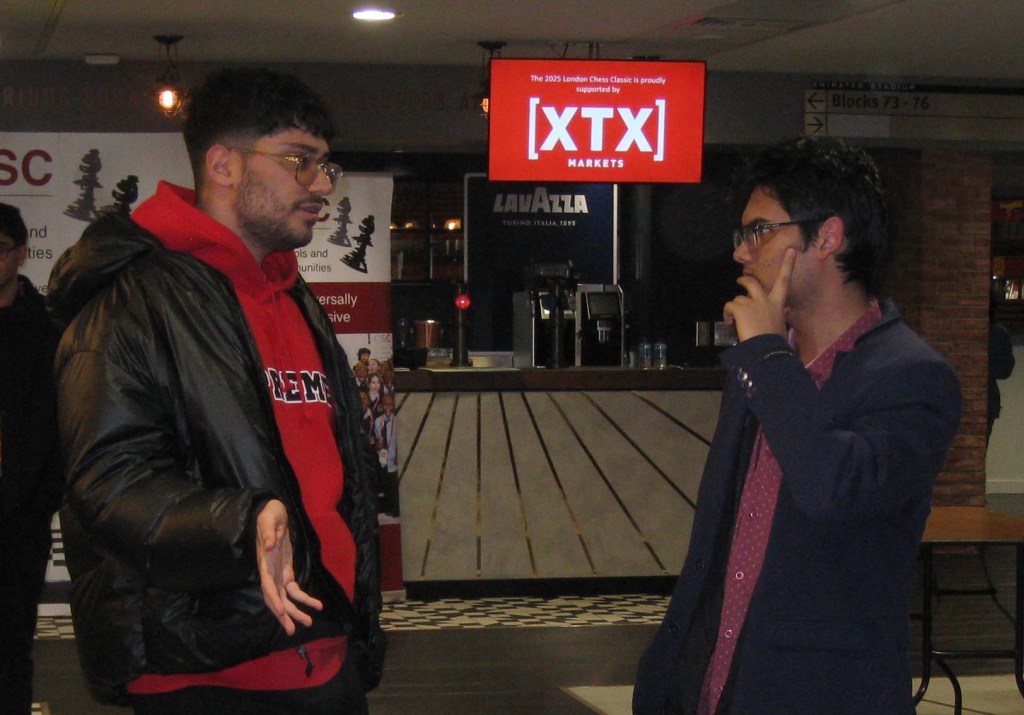
Firouzja and Mishra finish their match in a draw, shaking hands over the board. They reassess the game very quickly in quiet discussion before Firouzja grabs his black puffer jacket and heads out the room.
The teenager, now sporting a winter hat, chases after his opponent, catching him in the lobby where they speak more candidly amid a handful of spectators circling, hoping for a photo. I ask Mishra why the urgency to speak to his opponent. “Alireza is one of the best players in the world, I wanted to see what he thought of the game,” he says with almost childlike wonder.
The Emirates will swarm with the old familiar sea of red just two nights later when Arsenal play Brentford but, on a cold Monday night in December, it played host to the pinnacle of a different sport. I walk back around the concourse, now into the cutting winds, with a new perception of chess.
Just as in so many sports, elite professionals at the top of their game can engender a transfixing spectacle of drama, despair and exultation at the flick of a switch, and the move of a Queen.
Similar Posts
- TWIW: Hurling transforms Ruislip into Irish hub
- TWIW: Ten years on from Kaepernick, the Superbowl cannot hide Trump’s ugly America

- TWIW: There is more beneath the Americanised surface of ice hockey and Petr Cech is proof
- TWIW: Seats, not pockets, need to be filled first if British basketball is to explode
- TWIW: Van Veen grows from boy to man as darts continues to produce special moments and characters

- TWIW: Baller League, where the fun never stops. Even when it should.
 Jack McRae writes...