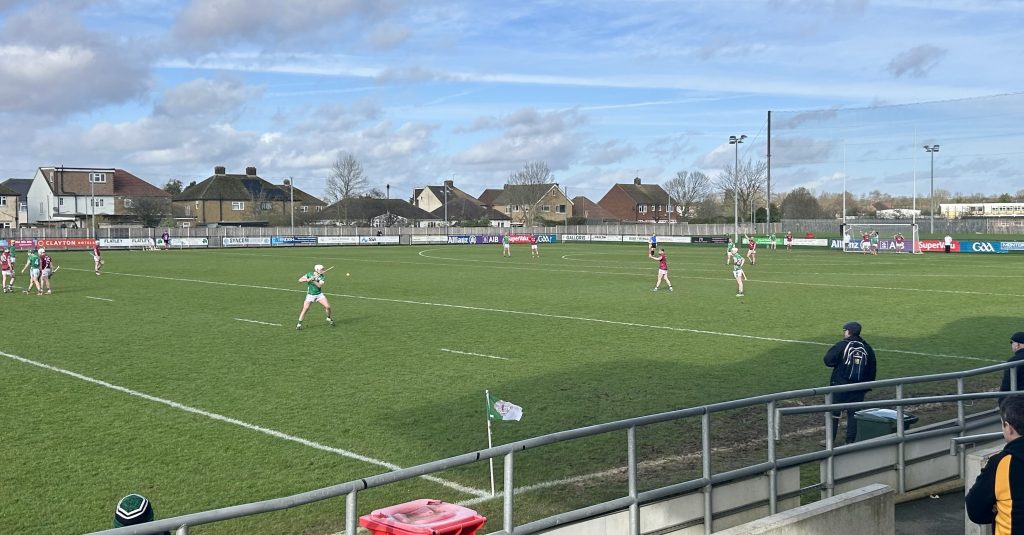
This week I watched hurling. There was not an awful lot going on around South Ruislip Underground when I stepped out of the station third from last on the Central Line. With just a scattering of corner shops and the sporadic whir of a jet engine coming into land at RAF Northolt, it felt like a stop-gap, a go-between from central London to a distant suburban sprawl – not a home, not a community.
The walk from the Tube to McGovern Park was not idyllic. The heavy winter rain had swamped the pavement and grassy verge that runs along the main A-road which races in and out of the capital. Mud was strewn across the path and the passing vehicles threatened to splash murky puddles at every opportunity.
Signs of human life began to creep in the closer I walked to the 2,000-seater ground. I soon realised that the man, sporting a green O’Neill’s sports top and walking in my direction, was probably heading to the same game as me. The parents hurrying along their children, carrying hurleys and helmets, into cars after a morning practice was the next telling sign.
McGovern Park looks like any other local sports club: a huge gravel car park, a pavilion with a handful of wooden benches and a vast net protecting that very carpark from stray balls flying over the posts. Outside there was a hut selling tepid burgers wrapped in foil to keep what remained of their heat in the neatly wrapped silver packages.
Guinness may have grown in popularity in recent years, but entering the clubhouse, it was difficult to spot anyone who did not have a glass filled with the dark stout or with its creamy trails left as evidence dripped down the sides. For £5 a pint of the Irish beer, you’d be forgiven for thinking you were still in London.
The clubhouse and the stands echoed with almost exclusively Irish accents. London has a strong Irish diaspora and the English capital has its own side competing against Irish counties in the Allianz Hurling League. The appetite for GAA is reflected in the over £4million spent renovating McGovern Park to make it a home for Irish sport in England – even playing a tinny version of the national anthem Amhrán na bhFiann before the game began.
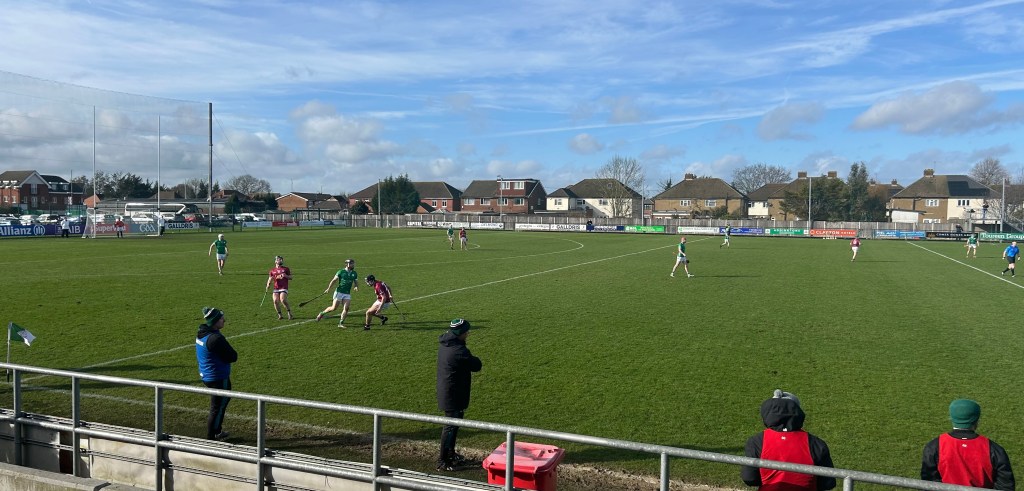
While there were maybe only 1,000 fans in attendance in Ruislip to watch London host Westmeath, I am not ignorant of the scale and seismic importance the sport has across the Irish Sea. I have always been amazed by how, despite being able to fill out Croke Park, hurling remains a completely amateur sport – players play and fans watch out of pure passion for their game and their county.
It was apparent that a number of those sitting around me were supporting Westmeath, with many likely family members or friends of the players who had travelled over. They cheered on the early goal from Eamon Cunneen and every time the dominant Shane Williams nipped in front of his man to catch the sliotar.
Westmeath overwhelmed London for much of the first half and led by 2-14 to 0-7. Goals, tallied by the first number in a team’s score, count for three points, with successful efforts over and between the posts, the second number, counting for one point each.
It seemed as if every time the visiting side hit the sliotar down pitch, the yellow ball would soar through the air and right between the posts.
Dean Ennis scored two goals either side of the break to put Westmeath in a commanding position, but London managed to save face in the second period as their opponents coasted in second gear to a comfortable victory – winning 3-22 to 0-20.
The sport was fast-paced and easy to follow. I was surprised at how much I got into it given, before this, I had only ever watched hurling in the background on a north London Irish pub’s beer garden television. My first memory of even knowing what hurling is was when Irish-born English cricketer Eoin Morgan credited playing the sport in his youth for why he could flash sixes with unorthodox switch hits in the late 2000s.
Now, I would like to think hurling will always be on my radar. It is affordable, there is a decent following outside of Ireland and the sport’s values and ties to its community are deeply entrenched. Other sports have seen money and fame warp its sense of purpose, lost in a greedy pursuit of revenues.
For much of the year, there will be little to see or do in South Ruislip. It may feel detached from the rest of London and a distance from the National League in which London competes in, but every now and then, for a few short hours, South Ruislip is transformed from a small English suburb to the home of hurling and a small piece of Ireland.
Similar Posts
- TWIW: Hurling transforms Ruislip into Irish hub
- TWIW: Ten years on from Kaepernick, the Superbowl cannot hide Trump’s ugly America

- TWIW: There is more beneath the Americanised surface of ice hockey and Petr Cech is proof
- TWIW: Seats, not pockets, need to be filled first if British basketball is to explode
- TWIW: Van Veen grows from boy to man as darts continues to produce special moments and characters
- TWIW: Baller League, where the fun never stops. Even when it should.
 Jack McRae writes...