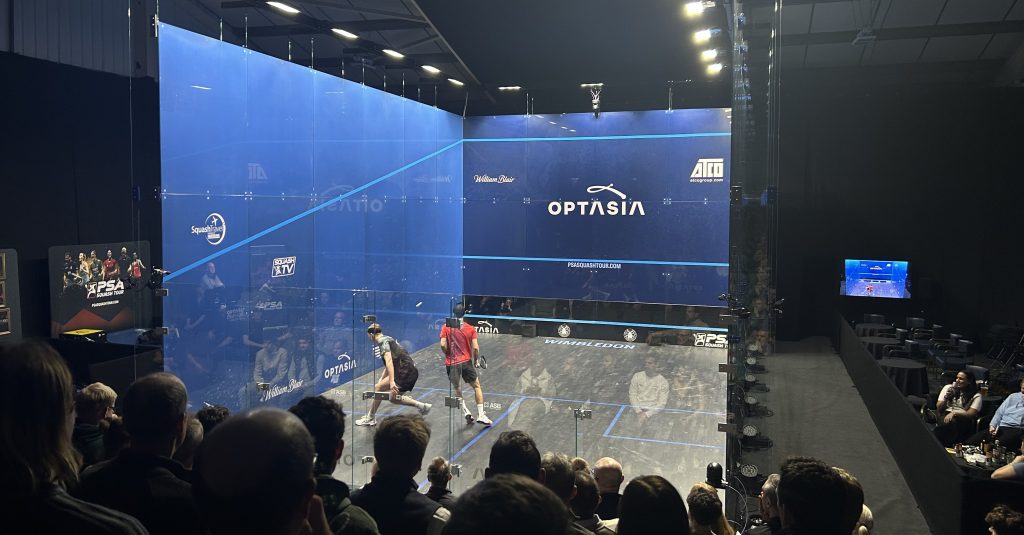
This week I watched squash. The hot, humid air in the Wimbledon Club enveloped me when I stepped out of the cold, windy night and through the sliding doors of the small building in SW19. The back of the stand partially blocked my view of the glass box from which the dull thud of the rubber ball echoed again and again.
I waited on the side, ensuring I avoided becoming a potential distraction as Lucy Turmel prepared to serve. The 26-year-old, ranked 31st in the world, knocked the ball up and down against the floor frantically, hitting the same spot on the grey surface restlessly.
Turmel was locked in a tetchy battle with Torrie Malik, the middle child of five professional squash-playing siblings and daughter of former player Camron Malik. The 21-year-old Malik took the second game to level at 1-1 and allowed me to take my seat towards the back of the stand.
Turmel and Malik scrapped for every point. They were playing cat-and-mouse, squeezing every inch of space on the 32 by 21-foot court. Each Malik point was roared on by a pocket of close family and friends as the third game climbed to 10-10.
Turmel finally edged ahead by the two clear points required to snatch the third game, with a few marginal calls made by the referee falling in her favour. Malik was penalised with a stroke, a point awarded to the opponent for blocking their line to the ball, on more than one occasion. Both players protested frequently to the official, Malik declared one decision that went against her as ‘insanity’ amid grumbles about the refereeing from spectators.
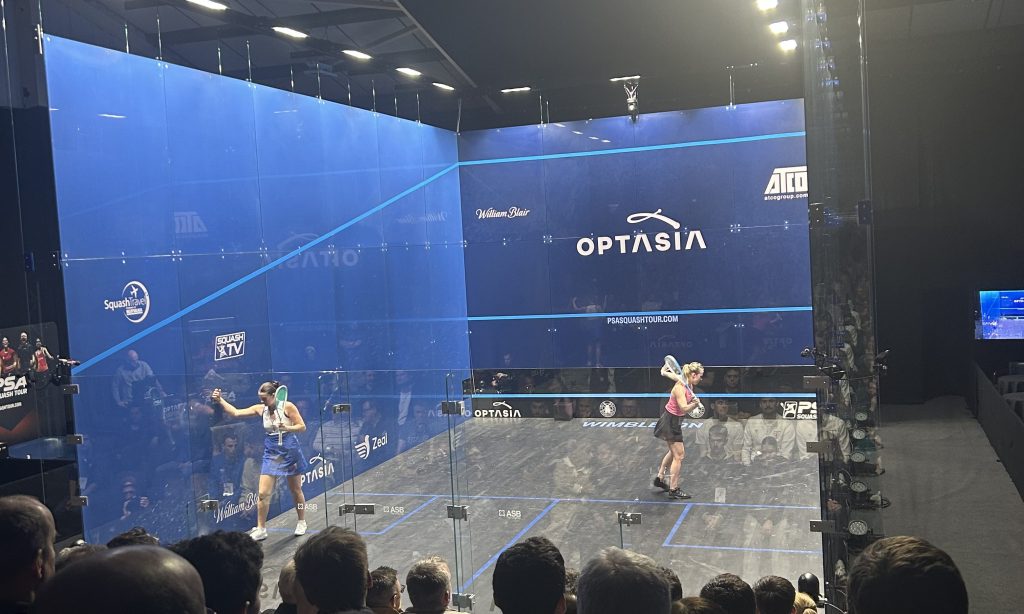
Players are allowed to challenge calls made by the referee, which prompted excessively dramatic music to start playing in the background, including Eminem’s ‘Lose Yourself’.
The rap song’s opening verse famously begins with, “his palms are sweaty, knees weak, arms are heavy”. It’s a fitting choice for a squash tournament because I was struck by how, after almost every point, each player would turn to the wall and drag their sweaty palms down the sides, as a way of drying their slippery hands.
The physical exertion required from the players was even exhausting to watch. Turmel and Malik chased, hunted and stretched every sinew to keep play alive, the latter finding spare energy to take the fourth game and tie the scores at 2-2.
With the match ticking towards the hour mark, Malik had the momentum. She pushed on and raced through the fifth and final game, winning 11-2 and sealing victory over the energy-sapped Turmel.
Already running behind schedule, on rushed Sam Todd and Juan Vargas. The former, a 23-year-old from Leeds, sported a white headband and had brought a small following. I sat amongst the Todd fans, whose bellowing Yorkshire accents echoed throughout the room.
Vargas, the 30th best player in the world from Colombia, had his own backing. Chants in Spanish pushed the 31-year-old on to victory against the Englishman who threatened to cause an upset by dragging the match into a fifth game.
Vargas cut an increasingly frustrated figure on the court, angrily stamping his feet which squeaked over patches on the floor that had become slippery. The sweat dripped off of the players and onto the floor, causing the Colombian to lose his footing on more than one occasion.
There was something fascinating about the tactical approach of the players. Their rallies, which often ended up in the back left corner as they hit long, raking backhands tight against the wall, resembled two ballroom dancers gliding around one another in a synchronised performance.
In the end, Vargas eventually had too much for Todd, who was unable to maintain his high-octane levels of the previous games. Even the shouts of “Shot Sambo!” had faded as the elder player stepped up and won the match-deciding game 11-2.
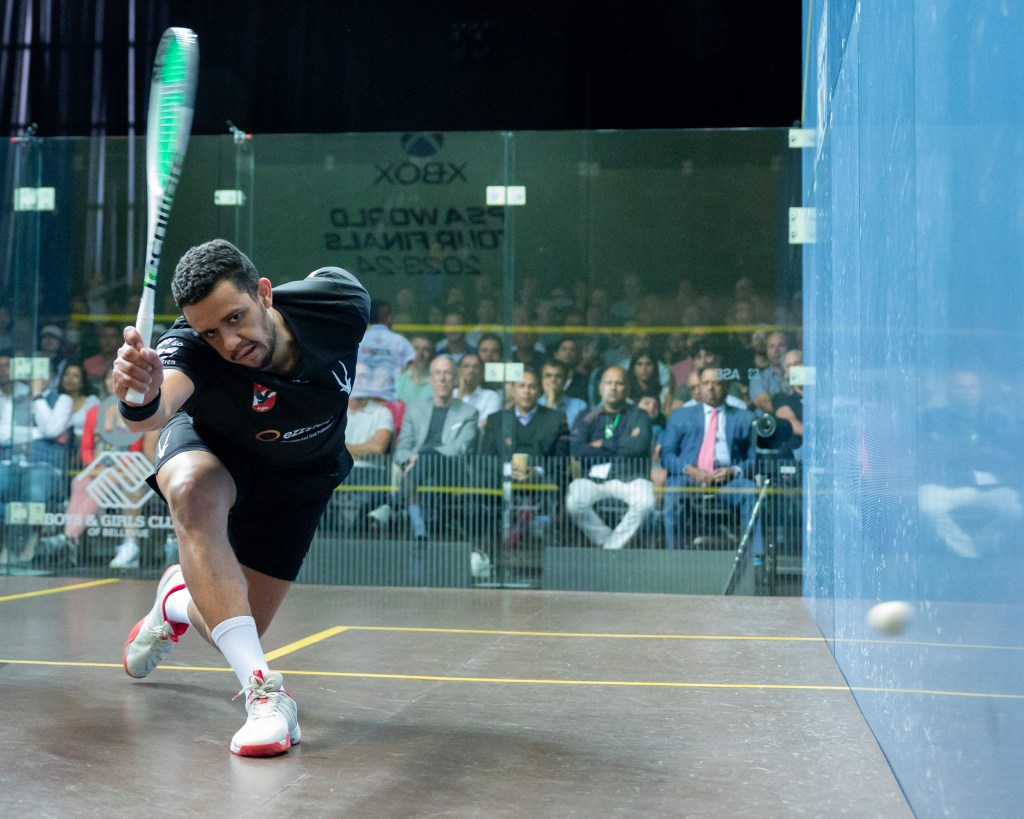
The final two matches of the night were slightly less tense than the opening pairs. An all-Egyptian tie between Haya Ali and Hana Ramadan saw the former earn a 12-10, 5-11, 11-7, 12-10 victory. Ali maintained her composure and, despite frequent groans and shouts, Ramadan was unable to lift her performance to match her compatriots.
The night ended with a second victory for Team Malik, with Torrie’s elder brother Curtis earning a four-game victory over Patrick Rooney. Malik, dressed in all white with a headband, pumped his fist in the direction of his family and friends who had witnessed the siblings progress to the next round.
Each of Tuesday night’s victors would be knocked out of the competition in the second round, with Mostafa Asal and Diego Elias and Hania El Hammamy and Nour El Sherbini set to face off in the men’s and women’s finals on Sunday respectively.
Egyptian players Asal and El Hammany are looking to defend the titles they won last year. Asal, nicknamed ‘Raging Bull’, has a tendency to stray beyond the lines of sportsmanship, but is the best player in the world and will keep that title regardless of success on Sunday. As for El Hammany, she will be determined to keep world number two El Sherbini from snatching her ranking at the pinnacle of the sport.
I had never watched professional squash before but, as I stepped out of the stuffy building and into the cool, dark night, the screech of trainers on the ground and the knockings of that rubber ball whizzing around the glass walls echoed in my head. It is an eerie and distinctive sound I will never forget.
Similar Posts
- TWIW: Sweaty palms, weak knees and heavy arms at the Squash

- TWIW: Formula One has changed and so has the way we consume it

- TWIW: Hurling transforms Ruislip into Irish hub

- TWIW: Ten years on from Kaepernick, the Superbowl cannot hide Trump’s ugly America

- TWIW: There is more beneath the Americanised surface of ice hockey and Petr Cech is proof
- TWIW: Seats, not pockets, need to be filled first if British basketball is to explode

 Jack McRae writes...