Photograph: Wikimedia Commons / Marcello Casal Jr/ABr
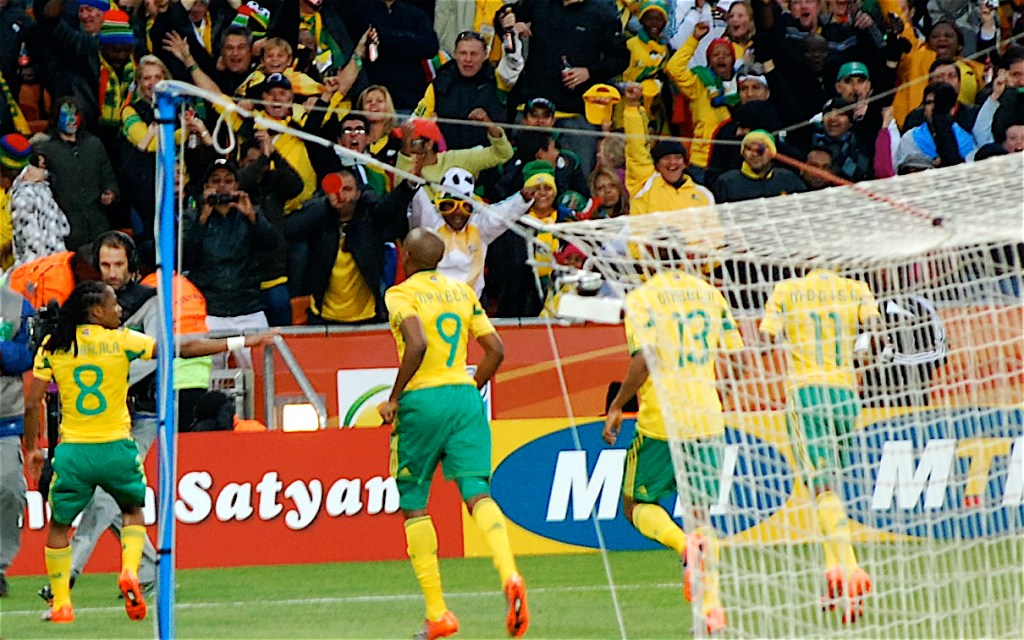
“It’s a really good ball. It’s Tshabalala! Goal Bafana Bafana! Goal for South Africa! Goal for all of Africa! Jabulile, rejoice… Bafana Bafana have popped the first cork!”
Siphiwe Tshabalala rocketed a shot into the top corner to put the hosts South Africa 1-0 up against Mexico inside the Soccer City Stadium in Soweto and Peter Drury’s voice echoed from televisions around the world.
The 2010 FIFA World Cup’s opening goal became an emblem of African progression, development and celebration. The continent’s long-overdue first World Cup was marked by unity and Pan-Africanism – a façade which hid the fractious society beneath it.
16 years on from that first game in Soweto and football’s complicated relationship with power is no less tangled. Mexico will host Bafana Bafana this evening as the latest tournament gets underway amid concerns around United States President Donald Trump’s unravelling sanity and war-mongering.
Yet, as it so often does, the football can mask the tensions that bubble under the surface. There was widespread xenophobia in South Africa which grew unchecked following the fall of apartheid and was only intensified by the World Cup.
Even now, there remains an undeniable xenophobic attitude that holds South Africa as attacks rain down on immigrants. Earlier this week, 171 Malawians were repatriated amid fears of violence.
Ahead of the tournament in 2010, immigrants were warned that they had to return home immediately after the last ball was kicked as the attitudes which prompted the 2008 riots that resulted in 62 deaths were pushed out of sight and out of mind.
This set a precedent with FIFA and its prestigious tournament. The stadiums built controversially in 2014 for Brazil that remain empty, the obvious implications of cozying up with Vladimir Putin in 2018 and the thousands of migrants killed building infrastructure in Qatar for the 2022 World Cup illustrate a destructive pattern.
Four years ago, my dissertation for my history degree was titled: ‘The 2010 FIFA World Cup’s Complicity in South Africa’s Rising Tide of Xenophobia.’ On the eve of another tournament, I read over it again.
Those who govern the most popular sport in the world have, and continue to, placate the whims and wishes of authoritative politicians and regimes. The livelihoods of normal people have long been neglected and there is little to suggest a deep-rooted passion for growing football at a grassroots level exists.
In its current form, the focus of the World Cup is not to spread the game, which football can do so already organically, but to eke out as much capital as possible and curry favour with powerful leaders of wealthy countries.
The South African problem
For nearly 30 years, from the 1960s to the early 1990s, apartheid and international boycotts isolated South Africa from an increasingly globalised world, while the government’s racist policies deepened the divide across its borders.
These policies encouraged White migration and discouraged Black migration. With society split across binary racial lines, African migrants tended to be considered as allies in the struggle against apartheid.
When the heavy restrictions of apartheid lifted, South Africa became a beacon of hope for African migrants. Deputy President Thabo Mbeki’s ‘I am an African’ speech in 1996 was a call for unity. South Africa’s successes were Africa’s, and Africa’s successes South Africa’s.
The ending of a racist regime and the birth of a new South Africa was supposed to have corrected the severe wealth and opportunity gap. Yet by 1997, national youth unemployment was 52 per cent, in Soweto it was 70 per cent.
This pattern repeated the following decade, when the nation was to host Africa’s first ever World Cup. Mbeki succeeded Nelson Mandela to become President in 1999 and oversaw the successful bid to host the tournament.
Mbeki declared the tournament would further help bridge the divide between the wealthiest White people and the poorest Black people. The tournament promoted South Africa to White tourists as an idyllic nation which continued to heal racial divides left from apartheid.
South Africa was once again offered hope of jobs, opportunity and prosperity. Between 2000 and 2010, immigration doubled and youth unemployment remained above 50 per cent.
The World Cup did bring public funding, but the significant sums of money poured into infrastructure, be it five new stadiums, major airports or fan parks, did less than trickle down. Frustration grew and the poorest individuals were turned against each other.
Communities were pitted against one another for public investment projects. Increased immigration levels did little to suggest that competition for these pots of money was going to get easier with time. Media helped demonise an influx of immigration and called for a ‘War on Aliens’. This was not the sentiment of a small minority, but a sweeping tide.
When violence broke out in the xenophobic riots in May 2008, Mbeki chose to dismiss this as just a small minority of bad actors. A nation swept up with a prevailing distrust and animosity towards African migrants was not the image of South Africa that Mbeki wished to portray to the world.
A year after the riots, Mbeki was replaced by Jacob Zuma and a strengthening of xenophobic rhetoric. Labelled the derogatory term ‘Makwerekwere’, African immigrants were targeted and even warned that if they did not leave South Africa immediately after the tournament’s final whistle they would be attacked – and the authorities would permit the violence.
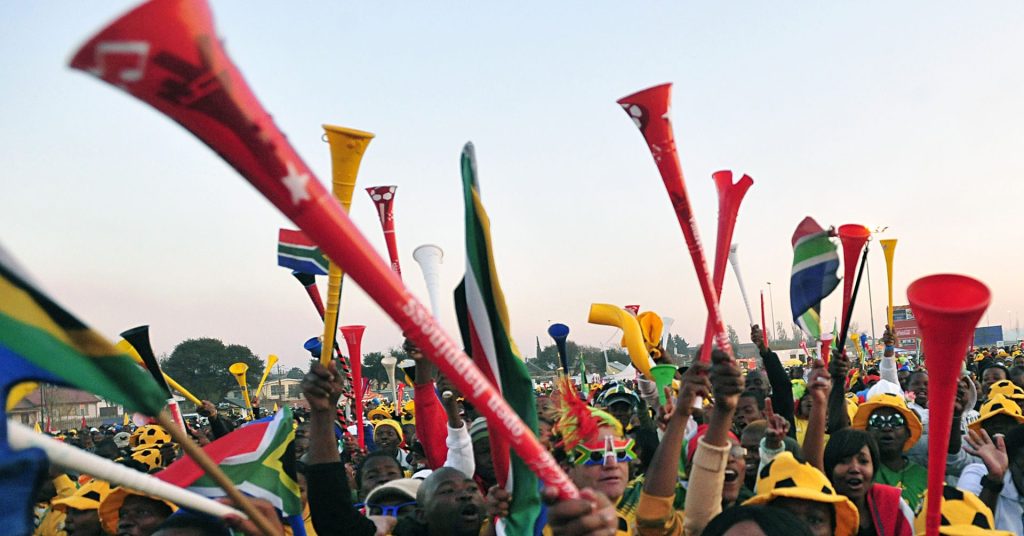
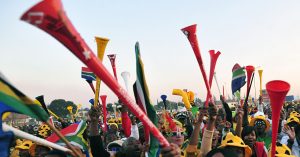
Everyone remembers the vuvuzela, the Howard Webb performance in the final and the goal for Africa, but this was never a story for Africa – South Africa’s bribing of FIFA officials to overlook Morocco in the bidding process is hardly a display of Pan-African unity.
The shiny vanity projects were built to appease the international community: the White, Euro-centric sponsorship and ambassadors.
And now, the vacuous stadiums remain largely unused 16 years on and stand as the symbols of a elitist tournament. The World Cup was billed as a global success, but the poorest South Africans did not receive their share of ‘success’.
The tournament did little to heal racial divisions either. Almost all of domestic support for South African clubs comes from its Black population. White South Africans tend to support English Premier League sides.
The World Cup created a safe space for White fans to go to games. Yet, once the tournament finished and South African football returned to the domestic game, so did its support. White fans, both South African and international, enjoyed the tournament and then moved behind their barriers.
The FIFA problem
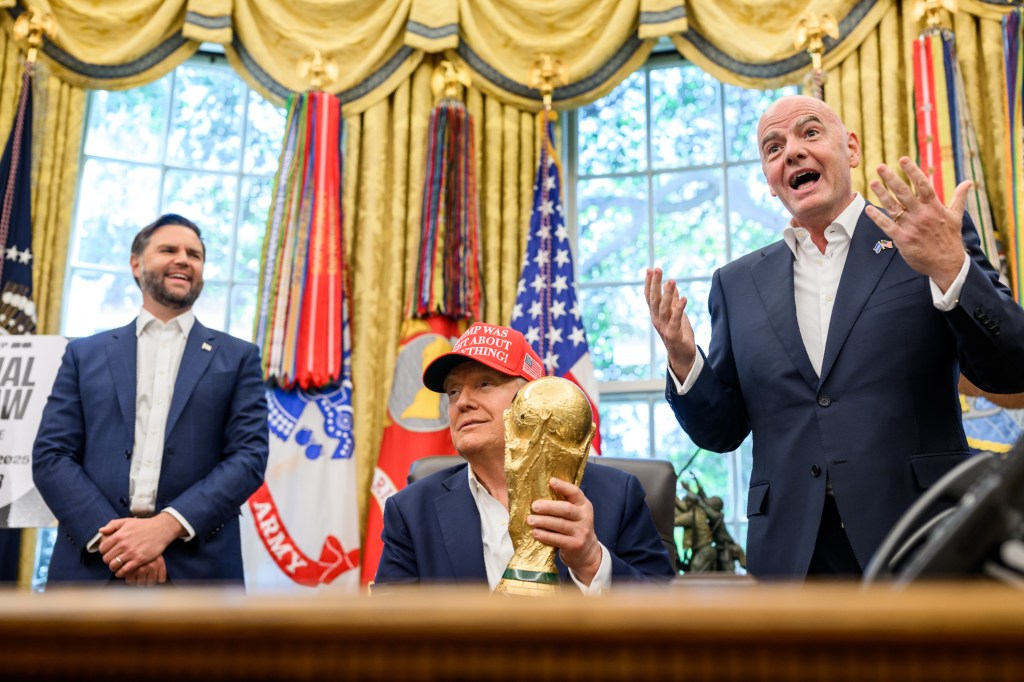
This was all pushed and enabled by FIFA. The Pan-African World Cup, despite the underlying hostility, was an opportunity for the governing body to expand its influence. The African World Cup was the individual, self-fulfilling project of Sepp Blatter.
The former President spoke of how he “will be proud because it is a little bit like my baby. I’ve had a dream for 34 years to bring the World Cup to Africa.” He knew that this ‘baby’ was a sure-fire way to flatter his way to five controversial terms as president with the votes from African delegates.
Blatter introduced a rule to rotate World Cup hosting rights between each continent which ultimately allowed South Africa to host the tournament in 2010. His successor, Gianni Infantino, followed the same playbook to all but hand the tournament to Saudi Arabia for 2034.
In 2020, Infantino announced the formation of an ‘African Super League’ and claimed that it “could generate an estimated $200m in revenue.” The project has already failed.
FIFA, and Infantino more specifically, have consistently demonstrated their ignorance of Africa’s socio-economic climate. His justification for a potential biennial World Cup was that more tournaments in Africa would allow “the whole world to give hope to Africans so that they don’t need to cross the Mediterranean in order to find maybe a better life but, more probably, death in the sea.”
Hosting a World Cup does not simply unite and heal divisions in a nation, particularly in a nation built on years of discrimination like South Africa. It is difficult to imagine the healing powers will work in the United States.
The real opportunities lie in the pockets of a select few. FIFA is unashamedly extorting football fans with egregiously priced tickets. It allows parasitical capitalism to reach deep into the pockets of anyone who wants to enjoy the sport. It enables sportswashing and strokes the egos of authoritarian leaders.
The saying ‘history repeats itself’ is so terribly clichéd. Yet, it is sickening to see the same thing happening time and time again. FIFA and Infantino have sold the sport to the highest bidder. Whether it is Putin, Trump or Mohammed bin Salman, there is little care about who controls the beautiful game.
For better or worse, the football has always masked this ugly truth. When Mexico kick off against South Africa tonight, all of the world’s issues and noise will fade momentarily. Only this time, the sport faces its toughest challenge to shut out the noise coming from the White House.
Similar Posts
- Accepting the inevitable: Mikel Merino is the most enjoyable player in the world
- No one wins the transfer window if we’re all losers

- How the vuvuzelas drowned out South Africa’s xenophobia and FIFA’s greed
- TWIW: Falling and flying with Arsenal in Budapest
- Nelson, Rice, Dowman: Maybe, finally, this is the moment
- 20 years after Arsène Wenger’s anniversary, how different are Mikel Arteta’s Arsenal?