This week I watched table tennis. “I know it’s hard to believe but I’m telling you, this game, it fills stadiums overseas and it’s only a matter of time before I’m staring at you from the cover of a Wheaties Box,” Timothée Chalamet’s Marty Mauser said, as he pitched table tennis to businessman Milton Rockwell (Kevin O’Leary).
It was impossible not to think of Josh Safdie’s Oscar-nominated film when I stepped into Wembley Arena’s colourfully lit hall. Marty Supreme managed to make table tennis mainstream and culturally significant on its release in cinemas in December 2025. Chalamet’s captivating portrayal of the narcissistic, yet magnetic, character, based on real-life Marty Reisman, was enough to even convince the most apathetic viewers to take notice of a sport usually sidelined in the Western world.
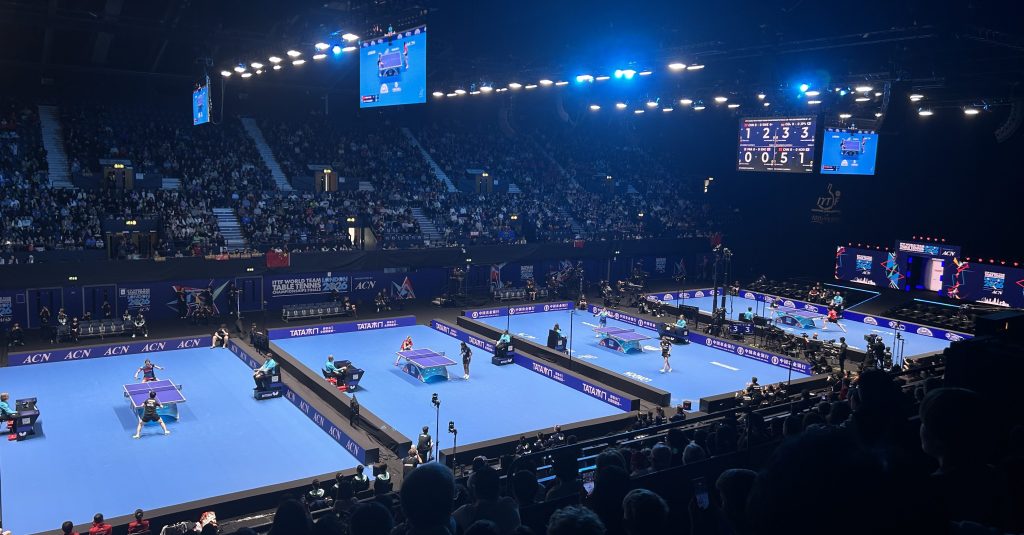
The 12,500-seater venue hosting the ITTF World Team Table Tennis Championships is not quite comparable to the massive football stadium within eyeshot, nor was the arena completely filled, but a bubbly hum rolled across the dimly-lit seats.
Despite Marty Supreme becoming production company A24’s highest-grossing film in the UK, earning just over £16 million by early February, it is difficult to tell whether it has converted cinephiles into table tennis fans.
Reisman, or Marty Supreme, was mentioned several times in the build-up to the action as the sport seeks to cling to the coattails of its new place amongst the zeitgeist. The centenary tournament was hosted in London, as it had been in its first iteration in 1926, but there was no denying which country was the firm favourite.
Ahead of the introduction of the eight different teams to take to the court, the arena announcer asked for fans of different countries to make noise for their respective nations. The small whoop that went up for the English team was closer to a whimper and was ultimately drowned out by a roar for the Chinese teams.
The nation’s dominance in table tennis this century is remarkable and can only be marvelled at. Since the sport debuted at the 1988 Olympics in Seoul, China has won 37 out of the 42 possible gold medals. Across the 20 players making up the top ten in men’s and women’s table tennis, eight are Chinese.
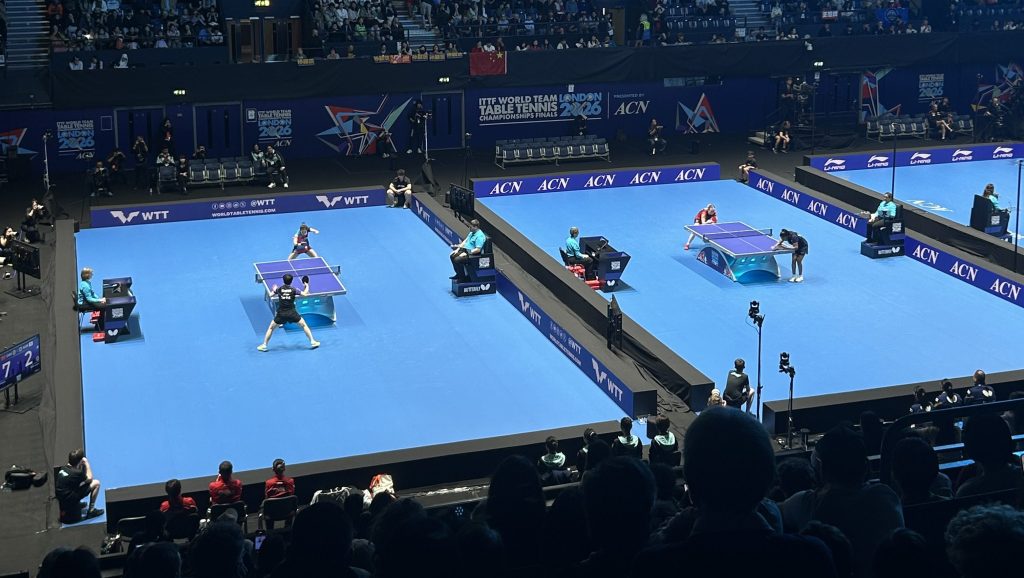
Wang Chuqin and Sun Yingsha, the best male and female players in the world respectively, were greeted by great fanfare, with chants of “Jiāyóu”, meaning “go” or “keep it up”, echoing from one wall of stands to the other.
The structure of the tournament involves individuals facing off in a best-of-five games in order to win a match for their team, with the first country to win three matches winning the tie.
While Sun and her team cruised past South Korea, winning 3-0 and becoming the first team to leave the court, there was more tension at the other end of the hall. The Chinese men’s side, who had lost their own previous tie to South Korea, were placed under pressure by Sweden.
When Truls Möregårdh beat Liang Jingkun by three games to two, he put Sweden ahead by two matches to one. The noise, or lack thereof, when China slipped behind or lost a crucial point was eerie. With no chanting or applause, you could hear every rippling bounce of the gleaming white ball skittering across the tables or away onto the floor.
China took Sweden to a fifth and deciding match between Anton Kallberg and Lin Shidong, but Kallberg clinched the victory in just four games. Before this weekend, the Chinese men’s team had not lost a tie at the World Team Table Tennis Championships since 2000. By Sunday evening, they had lost twice in 24 hours.
China’s men were unable to prevent back-to-back shocks with the support of most of the crowd, but England did not fare much better. The hosts were resilient but comprehensively beaten by France, who won three closely contested matches in a row.
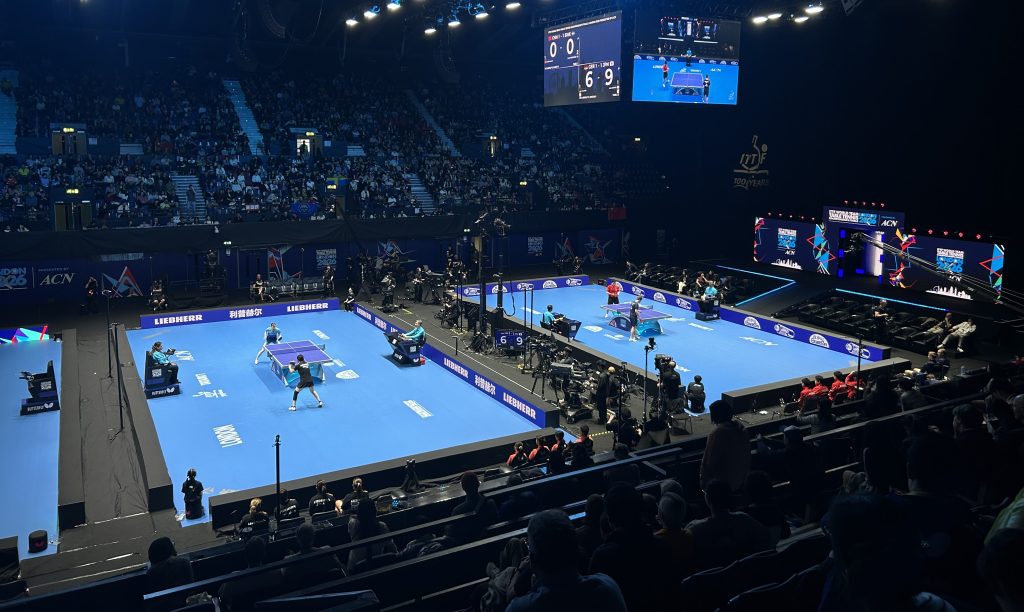
Tin-Tin Ho won two games against world number 24 Jianan Yuan, but succumbed in the fifth to the French player with one of the most eye-catching serves. It was sometimes tricky to follow exactly what was going on in four ties taking place simultaneously, but it was impossible not to become fixated by Yuan tossing the ball metres into the air, seeing it swirl and arc back down, before meeting it with a deft touch to knock it down against the table and over the net.
Japan were the other victors of the afternoon, beating Germany 3-1 to seal their spot at the top of Group Two. The Germans won only the first match of the tie, Annett Kaufmann pulling off a surprise victory against Miwa Harimoto, the 17-year-old prodigy who sits fifth in the world rankings.
The crowds left the arena and spilled out into the modern, commercialised surroundings under the famous arch of Wembley Stadium. The support may have been intensely partisan and many will have been disappointed to see China’s men lose again, but by breaking the strong grip one nation has held on the tournament for so long, Sweden’s success suggests that competition is growing.
Competitiveness is at the defining heart of sport. Without it, there can be no drama and it will be harder to sell tickets to fans across the world. Maybe the rise of the underdog, be it South Korea or Sweden, is coming at just the right time ahead of the 2028 Olympic Games in Los Angeles. Then, the competitive drama will matter more than the celebrity face on the front of an imaginary Wheaties box.
Similar Posts
- TWIW: Falling and flying with Arsenal in Budapest

- TWIW: Cricket needs to uproot the culture, not the game

- TWIW: Sweden shock China to usher in Marty Supreme era of table tennis
- TWIW: Aussie Rules has a home in London and is looking to grow

- TWIW: Free-flowing attacks and solid defences at London Pulse and the London Stadium

- TWIW: Sweaty palms, weak knees and heavy arms at the Squash

 Jack McRae writes...