This week I watched netball. The Mildmay line train from Highbury & Islington to Stratford pulled up just after 6.30pm. The overground was busy again – commuters, pub-goers and football fans loaded into the stuffy, burnt orange-coloured carriages. Men, young and old, swigged from cans of lager and swayed in tune with the rickety ride through Dalston, Homerton and Hackney to the Olympic Park.
Within moments of stepping onto the train, one of those cans slipped from a hand and cannoned off the floor, split open and sent the fizzing golden liquid trickling across the already sticky, discoloured surface. Some passengers stood still, resigned to the river of alcohol meandering towards the soles of their feet, while others stepped quickly away from the stream.
Most West Ham fans would have arrived at the London Stadium a different way, but there were more than a few who joined me in hopping off at Hackney Wick. The route out of the station is filled with graffiti – mostly political, some artistic and one tagged: Duncan Aged 53½.
The smells of the food trucks and pop-up barbecues followed me over the bridge into the former Olympic village, where the difference in crowds became increasingly stark. The football stadium came into eyesight when I walked up the familiar stairs to the Copper Box, where I have been to see Baller League and the London Lions.
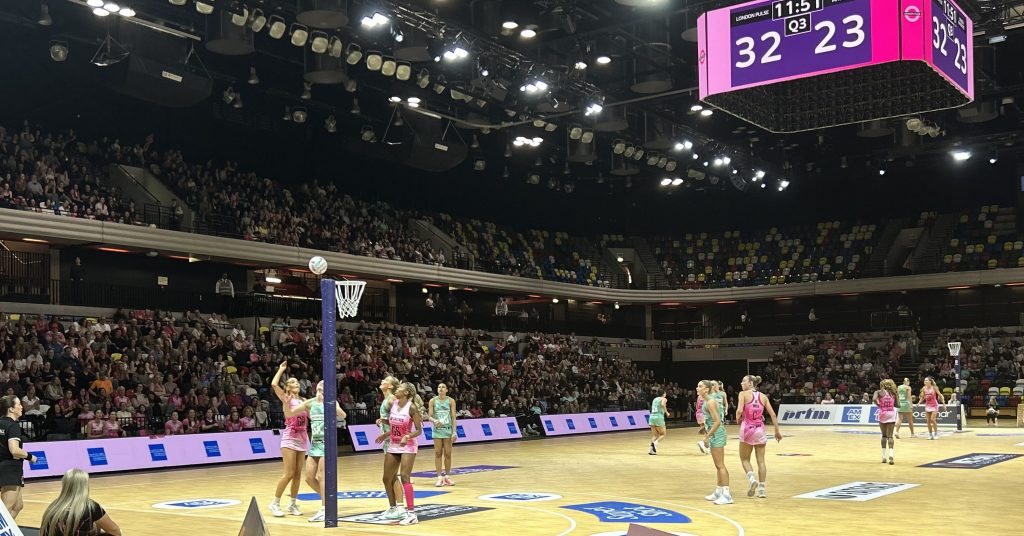
The early trickle of Hammers fans carried on around the bend and in the direction of the 8pm clash with Wolves, but I joined the mazy queue of families for the Netball Super League game between London Pulse and London Mavericks.
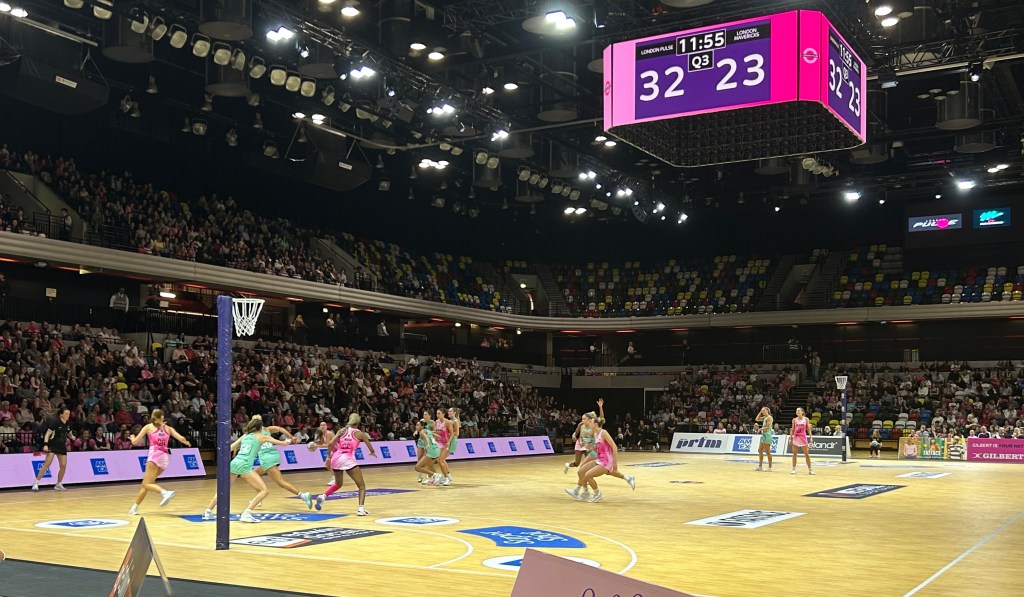
The noise from the arena could not have been more different from that of a football ground. It was Easter holidays and the lower tier was packed out by school children and youth netball clubs hollering for Pulse, the home side kitted out in all pink, who racked up a strong and early 12-1 lead after just 10 minutes.
Pulse dominated the opening quarter and seemed as if they would cruise to victory over their city rivals. The one-way traffic did little to engage a young crowd, more intent on winning a freebie from the t-shirt cannon in the interval. The children, encouraged to make as much noise as possible, produced shrill shrieks that threatened to pierce ear drums.
Despite the screams, my attention remained locked on the fast-paced moves on the court. Mavericks pushed back to keep Pulse within touching distance at half-time but they had been largely outplayed. The visitors, wearing their mint-green kit, were wasteful with their shooting and had been punished by the clinical pair of Kamogelo Maseko and Sophie Kelly.
I had never watched a full game of netball before Friday evening. I didn’t know quite how methodical and tactical a sport it is, or how fast-paced, dynamic and end-to-end it could be.
The constraints placed on players carrying the ball – unable to run, dribble or take more than a step with the ball, which must be released within three seconds of receiving it – force teams into unfurling instinctive and telepathic patterns of play that would have been practised until routine.
Like a great build up in football or a slick passing move to break the line in rugby, you could see how hours of endless running and passing, running and passing had produced these slick repetitions in which the ball would fly across court, seeking an opening in controlled and condensed spaces.
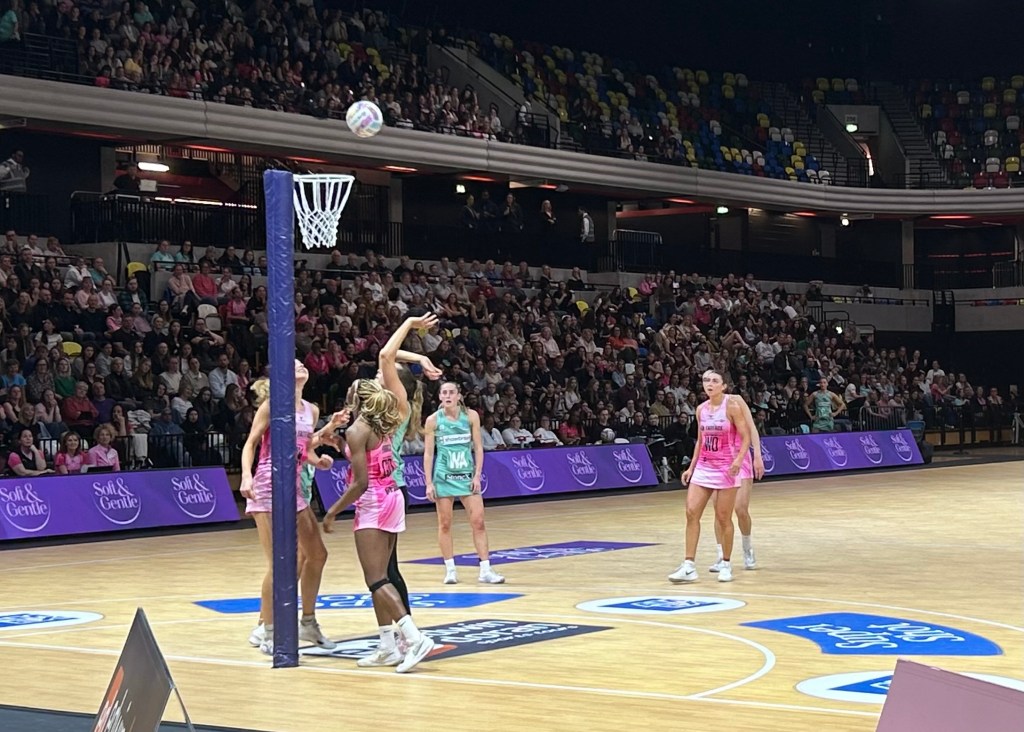
The goals rained down in east London and each time the ball slipped through the net the DJ had to play an obligatory five second snippet of a new song. Perhaps they did not realise quite how deep their song catalogue needed to run when the earlier Chappell Roan or Olivia Rodrigo staples were replaced by Baby Shark and Silento’s ‘Watch Me (Whip / Nae Nae)’ later in the game.
Mavericks’ resurgence continued in the third quarter, and they cut a ten-point lead to just four with the final 15 minutes on the clock remaining. The visitors piled pressure on Pulse and the previously jovial chants of ‘defence’ by a young crowd turned into a passionate rally.
Eventually, Mavericks’ wayward shooting would prove too costly – converting just 40% of their shots into goals. When compared with the 83% success rate of Pulse, it is clear to see exactly where the visitors fell short. Maseko and Kelly’s 27 and 16 goals, respectively, played a huge role in securing the eventual 56-46 win, but Funmi Fadoju’s three rebounds and all-round defensive play provided that strong foundation.
A sturdy defence and clinical shooting have been hard to come by at the Olympic Park in recent months, but Pulse provided just that a mere few hundred metres from West Ham’s new home at the converted Olympic stadium.
I made my way back to the train station and checked my phone to see the notification of Konstantinos Mavropanos’ opening goal for the Hammers, who would go on to beat Wolves 4-0. It wasn’t just the Pulse who were capable of excellence after all.
I smiled and, stood amongst the family-oriented crowds on the platform at Hackney Wick, thought of the man whose spilt beer was likely still streaked across the train floor – we’d both had a good night.
Similar Posts
- TWIW: Falling and flying with Arsenal in Budapest

- TWIW: Cricket needs to uproot the culture, not the game
- TWIW: Sweden shock China to usher in Marty Supreme era of table tennis
- TWIW: Aussie Rules has a home in London and is looking to grow
- TWIW: Free-flowing attacks and solid defences at London Pulse and the London Stadium
- TWIW: Sweaty palms, weak knees and heavy arms at the Squash