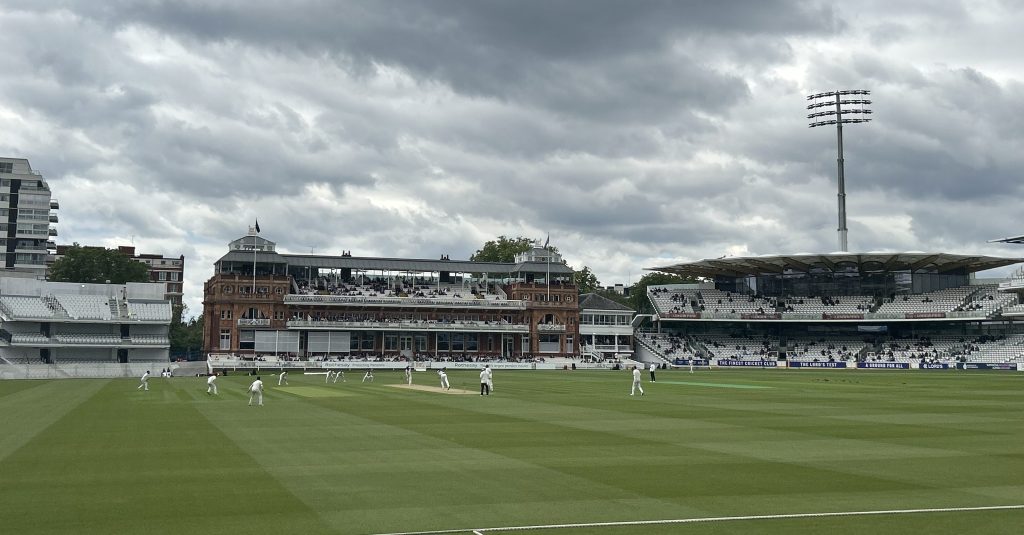
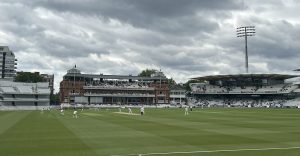
This week I watched cricket. The pavilion at Lord’s stands proud and defiant. Like a lonely lighthouse in a storm, the home of cricket is weathered by the ever-changing landscape around it. Its terracotta walls have watched over the sprawling, sloping outfield for more than a century. Every ball bowled, every run scored and every wicket taken has added a little note to the endless history of the ground in St John’s Wood.
Cricket has changed irrevocably in the years since the pavilion was first constructed and no more so than in the last 15. Left behind by the financial behemoth of Premier League football and unable to keep pace with the millions poured into the short-form game in India, the state of English cricket has left me feeling slightly dismayed.
I have not been taken by the Hundred, no matter how much it is pushed commercially. The 40 or 50 over game is virtually dead, with the exception of the World Cup. Test cricket is arguably at its most entertaining level in years, but with fewer international sides competing than ever, it is unlikely to have a true resurgence.
So, having paid my £20 admission, I walked through the gates at Lord’s with a bit of apathy. It was day two of the County Championship between Middlesex and Derbyshire, with the latter already batting and a handful of wickets down after ripping through the hosts in the first day.
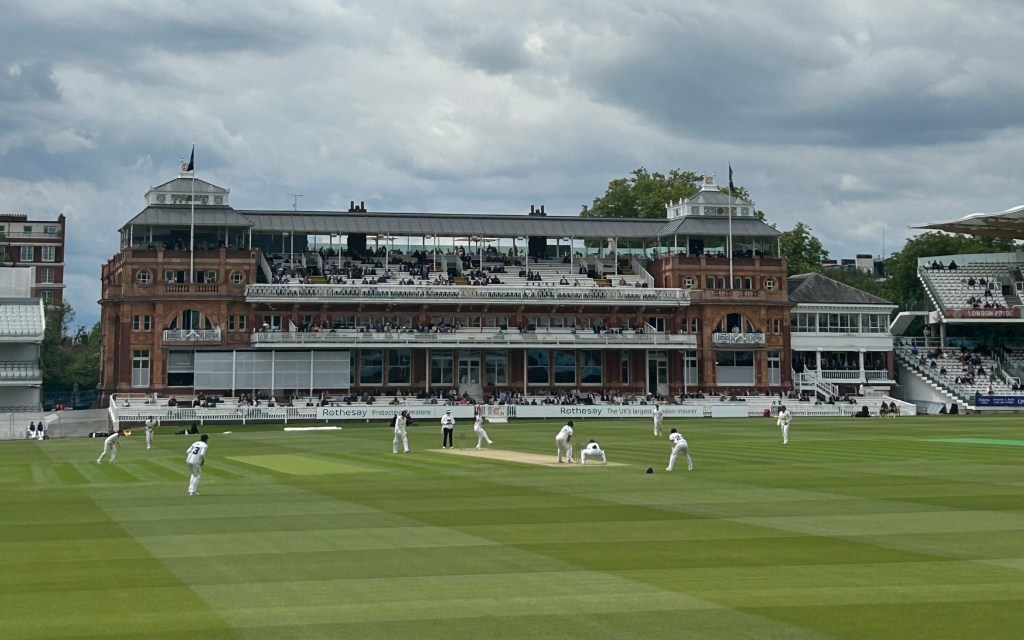
Only two areas at opposite ends of the ground, with the exception of MCC members in the pavilion, were open, but it was still free rein to take any seat available. There was a modest crowd. A lot of people were older and sat on their own, the Saturday morning paper in one hand and a coffee in the other. Some younger groups, like myself, were equipped with the last-minute Tesco Express meal-deal-curated picnic and cheap bottle of wine. A couple of families just enjoying a day out.
Long-form cricket is unique. Forever unfairly labelled as boring or dull or confusing, nothing compares to the way it ebbs and flows. A sea of tranquillity before being gripped by a storm in a moment. One wicket, one drop, one boundary and everything can change.
Lord’s was incredibly overcast and there was a whip of wind cutting through the gaps in the stands. There was a little chill, but not cold enough for the players to be shrouded in their white knitted jumpers. The perfect conditions for fast bowling.
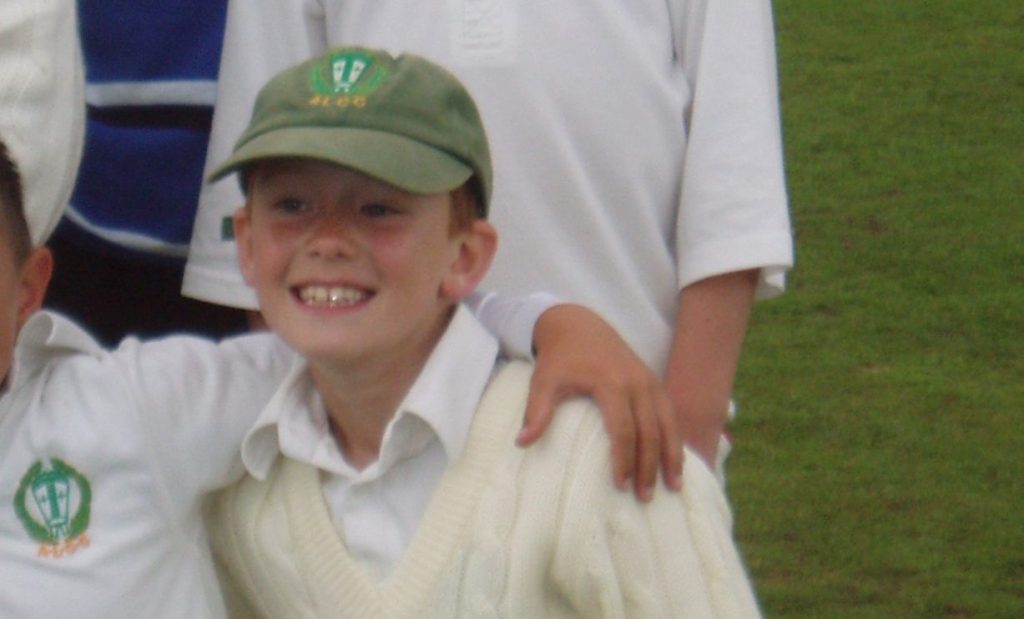
I played sport all through my childhood: football in the winter, cricket in the summer. I spent years of my life running up and down my garden, endlessly bowling balls with the aim of hitting a square of tissue or handkerchief on a good length on middle and off stump.
Channelling my inner Dale Steyn, Jimmy Anderson or Lasith Malinga, I subjected anyone, be it my parents or an unfortunate sister, to stand in front of the stumps and face my out-swinging deliveries. My bowling spell was only cut short and agonisingly when I was told I had to come inside to eat, do homework or get ready for bed.
It is a beautiful sight to see a fast bowler nip one away and take an outside edge. To dart one inside between bat and pad and crash into the stumps. To trap a batter, their feet cemented to the crease under their off-balance weight, with a quicker one that smacks into the pads. To whistle a ball past a helmet with a surprise short ball. It is an art.
Ryan Higgins must have fancied his chances on Saturday morning. Ben Aitchison and Nick Potts, two nightwatchmen, should have proved to be easy pickings and it did not take long for the bowler to dismiss Potts, who managed a respectable 31 from 55 balls. Higgins pitched it up, swinging it into the right-hander, and found the gap. The red ball hurtled between the bat, looking to drive through mid-off, and the front pad, careering into leg stump, which jumped out of the ground and cartwheeled away.
But the early wicket was not a sign of things to come. Aitchison, who had taken five wickets the day before, batted resolutely and picked off the bad balls to work his way to an admirable 50 alongside 42-year-old Wayne Madsen before lunch.
Madsen picked up the pace and his partner followed suit. The pair racked up the runs and were soon piling on a lead on the 177 set by Middlesex, scoring a century each and taking Derbyshire from 130-5 to well over 300. The 208-run stand was eventually broken after Aitchison skewed a Toby Roland-Jones ball to cover. Yet, even after Middlesex charged through the tail, taking the final four wickets for just 35 runs, the damage was already done.
Aitchison came out to open the bowling and immediately struck, dismissing Sam Robson for four runs – caught by Madsen, of course. The hosts were left staring defeat in the face at stumps – forced prematurely by a combination of bad light and rain – and were 13-1. Middlesex would go on to make a decent 320, but it was only enough to set Derbyshire a target of 121 to win – which they did by seven wickets.
Even with the stoppage for bad light, missing out on 30 overs of play and not being able to see Shoaib Bashir toss up some dogged off-breaks on an unforgiving wicket for spinners, it was still more enjoyable to watch than 20 five-ball overs of the Hundred.
I am not entirely sure what purpose the likes of London Spirit or MI London serve other than to ride the financial wave of the IPL. While I prefer longer games, I appreciate that the IPL is an immense product and it is not an evil in the sport. There is a space for T20 cricket, but English cricket fans should not be subjugated to a lesser, copycat version when there is such a little push behind grassroots support for the County Championship and, in turn, international Test cricket.
Maybe I am too stubborn, but when I was running in from the bottom of the garden to bowl at a set of stumps hammered into the ground at the top, I was dreaming of playing Test cricket. Who knows what I would have thought if I was told that the future of the sport involved five or ten-ball overs.
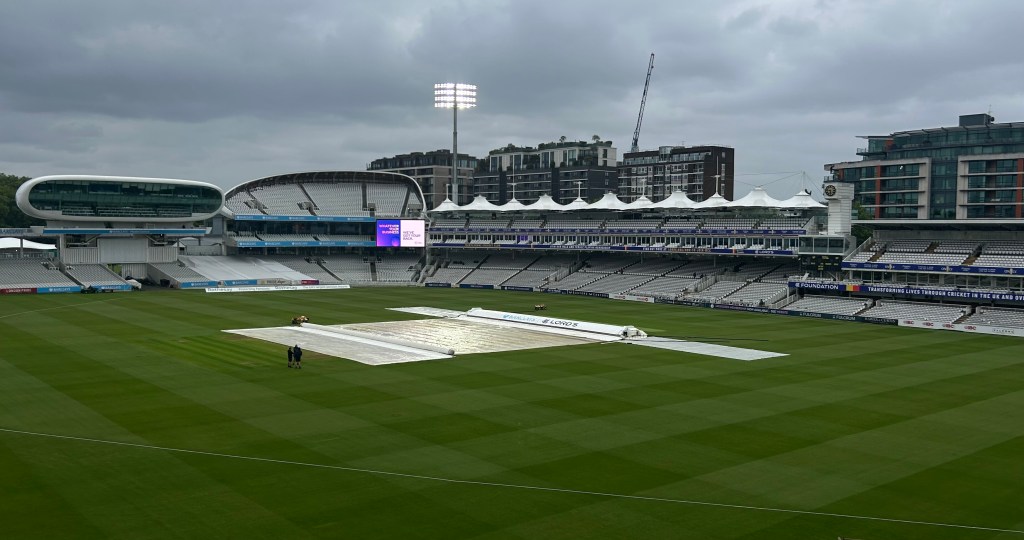
I fear for the long-form game and the minimal crowds at Lord’s did little to ease my concern. It could be that I am seeing something that so many millions are not, but cricket should be so much more popular to watch than it is.
There are barriers to entry, both in terms of playing and spectating, with cost being the key factor. Earlier this year, a Sutton Trust report found that 59 per cent of professional male and 50 per cent of professional female cricketers in the UK were privately educated. As per Wisden, male cricketers are a more privately educated demographic than the members of the House of Lords in Parliament.
There is such deep-rooted discrimination in sport in Britain, be it class, race, sexuality or gender. Cricket is not an exception to that. It has been built on those injustices and it does need to change. For 211 years, women were banned from being MCC members. Countless reports detail the hurt and pain that people involved in the sport have inflicted.
The Lord’s pavilion will remain, its protection as a listed building legally defining it as a historic reminder of what cricket once was and is, both the brilliant and the ugly. I hope that I can come back in 50 years, paper in hand, and look across at that old building with pride. Although that, let alone the prospect of holding a paper, feels sadly unlikely.
Similar Posts
- TWIW: Falling and flying with Arsenal in Budapest

- TWIW: Cricket needs to uproot the culture, not the game
- TWIW: Sweden shock China to usher in Marty Supreme era of table tennis
- TWIW: Aussie Rules has a home in London and is looking to grow

- TWIW: Free-flowing attacks and solid defences at London Pulse and the London Stadium

- TWIW: Sweaty palms, weak knees and heavy arms at the Squash

 Jack McRae writes...